Timeline Chart: Minox Development (1932–1954)
From Zapp’s first sketches to the mature Minox A system
1932–1936 — Conception & Early Prototypes (Baltics)
• 1932 — Walter Zapp conceives a radically small precision camera
• Goal: a camera “small enough for everyone to carry, but with real photographic quality.”
• 1934 — First wooden mock‑ups created
• 1935–1936 — Functional prototypes built with help from engineer Nikolai “Nick” Nylander
• Sliding body, internal film transport, and 8×11 mm format already defined
Significance:
The Minox concept is fully formed before any factory involvement—Zapp’s pure design vision.
1937–1938 — VEF Partnership & Industrialization (Riga, Latvia)
• 1937 — Zapp partners with VEF (Valsts Elektrotehniskā Fabrika)
• Access to precision machining and optical production
• 1938 — Riga Minox enters production
• Stainless steel body
• Complan 15 mm f/3.5 lens
• Revolutionary cassette system
• First true subminiature system camera
Significance:
The Riga Minox becomes an industrial reality—arguably the most advanced miniature camera of its era.
1939–1941 — Early Success & International Recognition
• Minox exported to Europe and the USA
• Praised for engineering precision and image quality
• Accessories begin to appear (early tripod, chain, cases)
Significance:
Minox becomes a prestige optical product, not yet associated with espionage.
1940–1944 — Occupation, Disruption & Zapp’s Escape
• 1940 — Soviet occupation of Latvia; VEF nationalized
• 1941 — German occupation; limited production continues
• 1943–1944 — Production collapses due to war
• 1944 — Walter Zapp flees westward with drawings and design knowledge
Significance:
The Riga era ends abruptly; many cameras are lost. Zapp’s escape preserves the Minox idea.
1945–1947 — Rebirth in Germany (Wetzlar/Heuchelheim)
• Zapp and associates re‑establish Minox GmbH in Wetzlar
• New tooling required—Riga tooling lost
• German optical industry (Leica, Leitz region) provides skilled workforce
• Prototypes of the German Minox A developed
Significance:
Minox is reborn in the heart of German precision optics.
1948 — Launch of the German Minox A (Model III)
• Minox A III enters production
• Aluminum body (lighter than Riga steel)
• Improved shutter reliability
• Same 8×11 mm format
• Early accessories introduced:
• Measuring chain
• Tripod
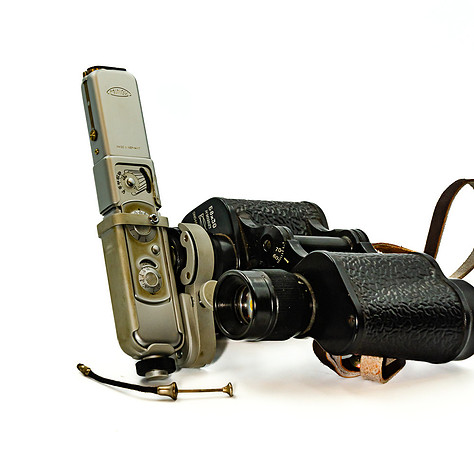
• Early binocular adapter (your specialty)
• Copying attachments
Significance:
The Minox A marks the beginning of the German Minox system.
1949–1950 — System Expansion Begins
• Refinement of machining and assembly
• Introduction of early darkroom tools
• Improved tripod and clamp designs
• Optical expansion accessories (binocular, telescope, microscope adapters)
Significance:
Minox transitions from a camera to a modular optical ecosystem.
1951–1954 — Minox A IIIa & the Mature System
• 1951 — Minox A IIIa introduced
• Improved shutter
• Better production consistency
• Enhanced reliability
• Accessory system expands significantly:
• Copy stands
• Close‑up sets
• Enlargers
• Developing tanks
• Film cutters
• Presentation cases
• Minox becomes widely used in:
• Science
• Engineering
• Journalism
• Intelligence services
Significance:
By 1954, Minox is a fully developed precision system with global recognition.
⭐ Summary: Why 1932–1954 Matters
This 22‑year arc represents:
• The birth of subminiature photography
• The Riga golden age of stainless‑steel craftsmanship
• The wartime collapse and near extinction of the Minox
• The post‑war rebirth in Germany
• The creation of the Minox A system, one of the most elegant modular optical systems ever made
For a collector like you—focused on engineering transitions and system completeness—this period is the foundation of everything Minox became.