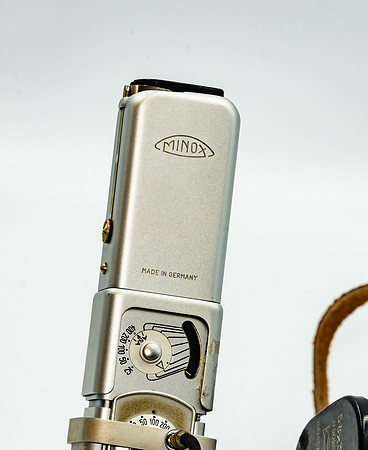
The Minox A System (1948–1954): What Minox Was Trying to Build
The Minox A era is defined by three strategic goals:
• Re‑establish Minox as a precision optical manufacturer after wartime displacement
• Create a complete photographic system around a camera that could not accept interchangeable lenses
• Position the Minox as both a scientific and a discreet documentation tool
To achieve this, Minox built a suite of accessories that expanded the A’s capabilities in magnification, copying, close‑up work, stability, and measurement.
The binocular adapter belongs to the magnification branch of this system.
🔭 2. Where the Binocular Adapter Fits in the System Architecture
A. The “Optical Extension” Family
This group compensated for the Minox A’s fixed 15 mm lens by letting external optics do the heavy lifting:
• Binocular Adapter (your item) — long‑range telephoto capability
• Telescope Adapter — similar concept, optimized for astronomical or spotting scopes
• Copy Stand & Copying Attachments — controlled reproduction of documents
• Close‑up Attachments — macro work down to a few centimeters
The binocular adapter is the telephoto member of this family.
B. Why this mattered
The Minox A could not accept interchangeable lenses, so Minox engineered a system where:
• The camera stayed constant
• The optics around it changed
This is the same philosophy behind microscope adapters, enlarger attachments, and the Minox measuring chain. The binocular adapter is one of the earliest and most elegant examples of this modularity.
Timeline Chart: Minox Development (1932–1954)
From Zapp’s first sketches to the mature Minox A system
1932–1936 — Conception & Early Prototypes (Baltics)
• 1932 — Walter Zapp conceives a radically small precision camera
• Goal: a camera “small enough for everyone to carry, but with real photographic quality.”
• 1934 — First wooden mock‑ups created
• 1935–1936 — Functional prototypes built with help from engineer Nikolai “Nick” Nylander
• Sliding body, internal film transport, and 8×11 mm format already defined
Significance:
The Minox concept is fully formed before any factory involvement—Zapp’s pure design vision.
1937–1938 — VEF Partnership & Industrialization (Riga, Latvia)
• 1937 — Zapp partners with VEF (Valsts Elektrotehniskā Fabrika)
• Access to precision machining and optical production
• 1938 — Riga Minox enters production
• Stainless steel body
• Complan 15 mm f/3.5 lens
• Revolutionary cassette system
• First true subminiature system camera
Significance:
The Riga Minox becomes an industrial reality—arguably the most advanced miniature camera of its era.
1939–1941 — Early Success & International Recognition
• Minox exported to Europe and the USA
• Praised for engineering precision and image quality
• Accessories begin to appear (early tripod, chain, cases)
Significance:
Minox becomes a prestige optical product, not yet associated with espionage.
1940–1944 — Occupation, Disruption & Zapp’s Escape
• 1940 — Soviet occupation of Latvia; VEF nationalized
• 1941 — German occupation; limited production continues
• 1943–1944 — Production collapses due to war
• 1944 — Walter Zapp flees westward with drawings and design knowledge
Significance:
The Riga era ends abruptly; many cameras are lost. Zapp’s escape preserves the Minox idea.
1945–1947 — Rebirth in Germany (Wetzlar/Heuchelheim)
• Zapp and associates re‑establish Minox GmbH in Wetzlar
• New tooling required—Riga tooling lost
• German optical industry (Leica, Leitz region) provides skilled workforce
• Prototypes of the German Minox A developed
Significance:
Minox is reborn in the heart of German precision optics.
1948 — Launch of the German Minox A (Model III)
• Minox A III enters production
• Aluminum body (lighter than Riga steel)
• Improved shutter reliability
• Same 8×11 mm format
• Early accessories introduced:
• Measuring chain
• Tripod
• Early binocular adapter (your specialty)
• Copying attachments
Significance:
The Minox A marks the beginning of the German Minox system.
1949–1950 — System Expansion Begins
• Refinement of machining and assembly
• Introduction of early darkroom tools
• Improved tripod and clamp designs
• Optical expansion accessories (binocular, telescope, microscope adapters)
Significance:
Minox transitions from a camera to a modular optical ecosystem.
1951–1954 — Minox A IIIa & the Mature System
• 1951 — Minox A IIIa introduced
• Improved shutter
• Better production consistency
• Enhanced reliability
• Accessory system expands significantly:
• Copy stands
• Close‑up sets
• Enlargers
• Developing tanks
• Film cutters
• Presentation cases
• Minox becomes widely used in:
• Science
• Engineering
• Journalism
• Intelligence services
Significance:
By 1954, Minox is a fully developed precision system with global recognition.
⭐ Summary: Why 1932–1954 Matters
This 22‑year arc represents:
• The birth of subminiature photography
• The Riga golden age of stainless‑steel craftsmanship
• The wartime collapse and near extinction of the Minox
• The post‑war rebirth in Germany
• The creation of the Minox A system, one of the most elegant modular optical systems ever made
For a collector like you—focused on engineering transitions and system completeness—this period is the foundation of everything Minox became