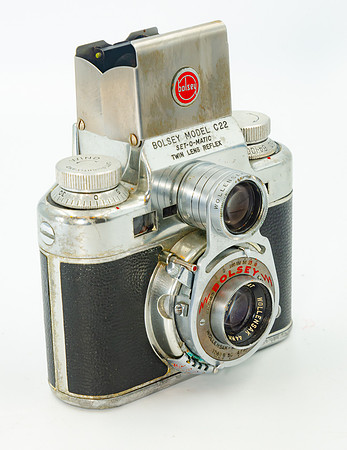
Origins and Manufacturing Context (USA, early 1950s)
The C22 was produced by the Bolsey Corporation of America, founded by Jacques Bolsey (Yakob Bogopolsky)—the Ukrainian‑born engineer who had earlier created the Bolex movie camera and contributed to the early Alpa Reflex design.
By the early 1950s, Bolsey was trying to carve out a niche in the crowded American 35mm market by offering compact, feature‑rich cameras with Swiss‑influenced engineering. The Bolsey C series (C, C22) was his attempt to bring the twin‑lens reflex concept—normally associated with medium format—into the 35mm world.
The C22, introduced in 1953, was the improved version of the 1950 Bolsey C, adding the Set‑O‑Matic flash‑coupled aperture system.
⚙️ Technical Characteristics
1. A 35mm Twin‑Lens Reflex (TLR)
Unlike medium‑format Rolleiflex‑type TLRs, the Bolsey C22 uses 35mm film (24×36mm).
• Viewing lens: Wollensak Anastigmat 44mm f/3.2
• Taking lens: Wollensak Anastigmat 44mm f/3.2
• Waist‑level reflex hood with pop‑up magnifier
This alone makes it historically unusual—very few 35mm TLRs were ever produced.
2. Coupled Split‑Image Rangefinder
In a highly unconventional design choice, Bolsey kept the rangefinder from the Bolsey B/B2 series.
• You can focus via the reflex screen or the rangefinder
• A separate optical viewfinder provides framing
This triple‑viewing system echoes Bolsey’s earlier work on the Alpa, which also combined reflex and rangefinder elements.
3. Set‑O‑Matic Flash Coupling (C22‑only)
The C22 introduced an automatic diaphragm computer:
• Aperture is mechanically linked to focusing distance
• Ensures correct flash exposure without calculations
This was a major selling point in the early 1950s, when flash photography was becoming mainstream.
4. Shutter and Build
• Wollensak Synchro‑Matic shutter, 1/10–1/200 + B + T
• Internal flash synchronization
• Cast aluminium body with black or beige leatherette
• “No‑double‑exposure” interlock
🌍 Historical Significance
1. One of the Only 35mm TLRs Ever Mass‑Produced
The C22 is part of a very small family of 35mm TLRs (others include the Zeiss Ikon Contaflex TLR and the Japanese Primo Jr 35). Its hybrid design makes it a fascinating evolutionary dead‑end in camera history.
2. A Showcase of Jacques Bolsey’s Experimental Vision
Bolsey was an inventor first, businessman second. The C22 reflects his:
• Swiss engineering background
• love of hybrid viewing systems
• desire to innovate beyond conventional camera categories
It is arguably the most eccentric of all Bolsey designs.
3. A Symbol of Post‑War American Camera Manufacturing
In the 1950s, the U.S. camera industry was overshadowed by Germany and Japan. The C22 stands out as a rare American attempt to produce a technically sophisticated 35mm camera with unique features.
4. Increasing Collector Interest
Collectors value the C22 because:
• it is mechanically unusual
• it has a distinctive Art‑Deco‑meets‑Modernist aesthetic
• surviving examples often show plating wear, making clean units desirable
• beige‑leatherette versions are especially sought after
🎯 Why the C22 Matters in a Historically Focused Collection
Given your interest in engineering transitions and historically significant designs, the Bolsey C22 is a perfect fit:
• It represents a unique hybrid in camera evolution.
• It embodies post‑war American innovation.
• It connects directly to Jacques Bolsey’s earlier work on Bolex and Alpa—two of the most influential camera lines of the 20th century.
• It is rare, quirky, and mechanically ambitious—exactly the kind of camera that rewards close study.