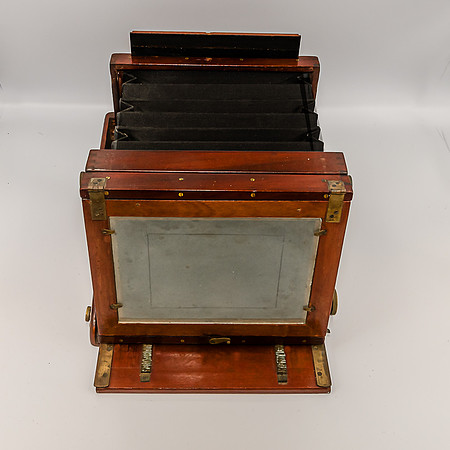
Half‑Plate Tailboard Camera c.1890
A tailboard camera is a type of view camera where the rear standard slides along the baseboard for focusing. It was one of the most common professional and advanced amateur cameras of the 1880s–1890s.
🧱 1. What a Tailboard Camera Is
A tailboard camera is defined by:
• Bellows between front and rear standards
• Rear focusing: the back standard moves forward/backward on the baseboard
• Folding baseboard (in most models), which becomes the “tailboard” when opened
• Ground‑glass screen for composing and focusing
This definition is confirmed by Camera‑wiki’s description of tailboard architecture.
🪚 2. Half‑Plate Format
• Half‑plate = 6½ × 4¾ inches (approx. 165 × 120 mm).
• A very popular professional format for portraits, landscapes, and stereoscopic work.
⚙️ 4. How a Tailboard Camera Worked
1. Open the baseboard (tailboard).
2. Extend the bellows.
3. Focus by sliding the rear standard along the baseboard.
4. Compose on the ground‑glass screen.
5. Insert a double dark slide with a glass plate.
6. Remove the dark slide → expose → replace slide.
This system offered:
• Precise focusing
• Movements (rise, shift, sometimes swing)
• Portability for field work
🧭 5. Why Tailboard Cameras Mattered
• Professional standard for studio and field photography in the 1880s–1890s.
• Highly flexible: interchangeable lenses, movements, plate sizes.
• Durable and portable: mahogany and brass construction.
• Precursor to modern large‑format field cameras