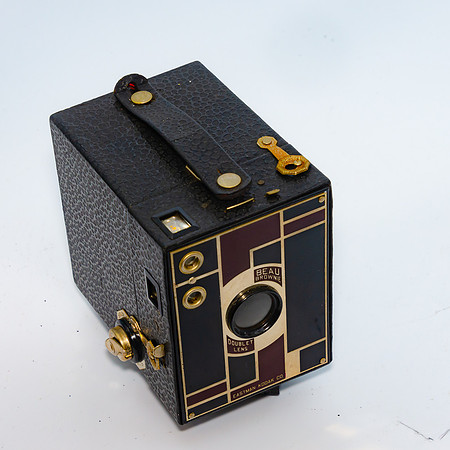
Beau Brownie Box Camera (c.1930): A Landmark of Art Deco Industrial Design
The Kodak Beau Brownie (1930–1933) is one of the most iconic Art Deco cameras ever produced, designed by Walter Dorwin Teague and released in five striking colourways. It represents the moment Kodak fused mass‑market photography with modernist design, turning a simple box camera into a fashionable object.
🏭 1. How the Beau Brownie Was Made
A collaboration between Kodak and Walter Dorwin Teague (1930)
• In 1930, Kodak hired Walter Dorwin Teague, a pioneering American industrial designer, to modernise the Brownie line.
• Teague applied pure Art Deco geometry, using polished metal and two‑tone enamel panels.
• The camera body was metal, covered in colour‑matched leatherette, a first for Brownies.
Models & Formats
Two versions were produced:
• No.2 Beau Brownie – used 120 film, image size 2¼ × 3¼ in.
• No.2A Beau Brownie – used 116 film, image size 2½ × 4¼ in.
Colours (all Art Deco two‑tone enamel)
• Black, Blue, Green, Rose, Tan
• Green and Rose were discontinued early (1931).
Optics & Mechanics
• Kodak Doublet lens (two‑element design), allowing a shorter body than typical Brownies.
• Rotary shutter with I (instantaneous) and B (bulb/time) settings.
• Three aperture choices via sliding levers.
• Two brilliant viewfinders for portrait and landscape.
🎨 2. Why the Beau Brownie Was Significant
⭐ 1. A breakthrough in consumer‑product design
The Beau Brownie is one of the earliest examples of industrial design applied to a mass‑market camera.
Teague’s work helped establish the idea that everyday objects could be both functional and stylish.
⭐ 2. Democratizing Art Deco
Art Deco was typically associated with architecture, luxury goods, and high fashion.
Kodak brought it to the general public, selling the Beau Brownie for around $4.25 USD—affordable even during the early Depression years.
⭐ 3. A cultural icon of the early 1930s
• Its bold colours and geometric enamel fronts made it instantly recognisable.
• It became a fashion accessory, especially among women photographers of the era.
• Today it is considered one of the most collectible Brownies due to its design and short production run (1930–1933).
⭐ 4. A turning point for Kodak
The Beau Brownie marked Kodak’s shift toward:
• Design‑driven consumer products
• Brand identity through aesthetics
• Long‑term collaboration with Teague, who later designed Kodak’s Bantam Special and retail displays
🧭 3. Why Collectors Value It Today
High desirability due to:
• Short production window (1930–1933)
• Early discontinuation of some colours (Green & Rose)
• Strong Art Deco identity
• Teague’s design pedigree
• Surviving examples often show enamel wear, so pristine units are rare
In the camera‑collecting world, the Beau Brownie is considered:
• A design classic
• A museum‑grade object (held in the Kodak Museum Collection, Science Museum Group)
• One of the most visually striking cameras of the 20th century
📌 4. In Summary
The Beau Brownie Box Camera is far more than a simple Brownie—it is a masterpiece of Art Deco industrial design, a symbol of Kodak’s design revolution, and one of the most collectible cameras of the early 20th century. Its combination of affordability, bold styling, and Teague’s design influence makes it a landmark in photographic and design history.