Historical Context (1957–1960)
Kodak Ltd. in the 1950s
By the mid‑1950s, Kodak’s British division in Harrow was:
• modernizing its Brownie line,
• shifting from metal to molded plastic bodies,
• adding flash synchronization to inexpensive cameras,
• competing with Agfa, Ilford, and a growing number of Japanese imports.
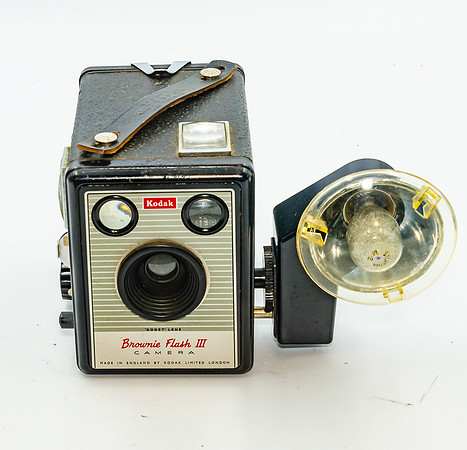
The Brownie Flash III was introduced around 1957 as part of a trio:
• Brownie Flash I
• Brownie Flash II
• Brownie Flash III (the top model)
These were designed to replace earlier metal-bodied Brownies and to offer a more modern, consumer‑friendly appearance.
2. Design and Construction
Body and materials
• Molded Bakelite-style plastic body
• Metal front plate with geometric decoration
• Large, bright optical viewfinder
• Side‑mounted shutter release
• Built‑in flash synchronization socket
Film and format
• 120 roll film
• Produces 6×6 cm square negatives
• Ideal for contact prints and album snapshots
Lens and shutter
• Meniscus lens (simple, fixed-focus)
• Shutter speed: approx. 1/40–1/50 sec + B
• Aperture: fixed (suitable for daylight snapshots)
Flash capability
The “Flash” designation refers to:
• a Kodak proprietary flashgun mount,
• synchronization via a simple contact,
• use of AG‑1 or PF1 flashbulbs.
This was a major selling point in the late 1950s.
3. Why the Brownie Flash III Was Important
1. The last generation of true Brownie box cameras
The Flash III represents the final refinement of a camera concept that began in 1900:
• simple box,
• fixed-focus lens,
• single shutter speed,
• affordable for everyone.
After this, Kodak moved toward:
• plastic snapshot cameras,
• Instamatic cartridges,
• 126 and 110 film systems.
The Flash III is the end of the classic Brownie era.
2. Brought flash photography to the masses
Before the 1950s, flash photography required:
• expensive equipment,
• complex synchronization,
• professional knowledge.
The Flash III made it:
• cheap,
• simple,
• accessible to families.
This changed how people photographed birthdays, holidays, and indoor events.
3. A British cultural icon
In the UK, Australia, and New Zealand, the Brownie Flash III became:
• a common family camera,
• a staple of school photography,
• a popular gift for children and teenagers.
It captured millions of family memories.
4. A design transition
The Flash III shows Kodak’s shift from:
• metal to plastic,
• ornate Art Deco styling to modern minimalism,
• traditional box cameras to more ergonomic designs.
It is a bridge between 1930s box cameras and 1960s Instamatics.
4. Collector Significance
Why collectors value it
• Represents the final chapter of the Brownie box lineage
• Attractive mid‑century industrial design
• Often found in excellent condition due to durable plastic
• A nostalgic object for British and Commonwealth collectors
Rarity
Not rare, but:
• boxed examples,
• with flashgun,
• with original paperwork
are increasingly desirable.
Display value
The Flash III has a distinctive, geometric front plate that makes it visually striking on a shelf.
5. Summary
The Kodak Brownie Flash III (c.1957) is:
• one of the last true Brownie box cameras,
• a key step in democratizing flash photography,
• a symbol of mid‑century British consumer design,
• an accessible and charming collectible today.
It marks the end of a 60‑year tradition of simple, affordable cameras that brought photography into everyday life.