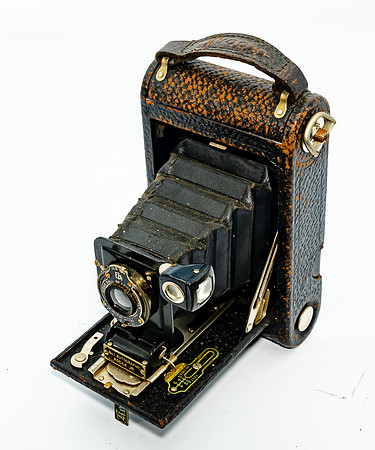
Kodak No.1 Autographic Junior (c.1920): History, Making & Significance
⭐ Why This Camera Matters
The Kodak No.1 Autographic Junior represents a pivotal moment in early 20th‑century photography: the transition from simple snapshot cameras to more versatile, user‑controlled folding cameras—while still keeping photography accessible to the masses. Its defining feature, the Autographic system, was a bold attempt to merge image and metadata decades before EXIF existed.
🕰️ 1. Historical Background (1914–1927)
📌 Origins
• Introduced in 1914 as an upgrade to the earlier No.1 Kodak Junior.
• Produced until 1927, with 800,000+ units manufactured—making it one of Kodak’s most successful folding cameras.
📌 The Autographic Innovation
• Kodak purchased the autographic process from inventor Henry Jacques Gaisman in 1914.
• The system allowed photographers to write notes directly onto the film backing using a metal stylus and a small rear door.
• Once developed, the writing appeared on the negative—an early form of embedded metadata.
• Although clever, the feature was rarely used, and Kodak eventually abandoned it.
🛠️ 2. Construction & Design (What Your c.1920 Camera Is Made Of)
🧱 Materials
• Aluminium body covered in seal‑grain leather.
• Leather bellows (sometimes cloth/paper in later examples).
• Nickel‑plated or black‑enameled metal fittings.
• Compact folding-bed design for portability.
🎞️ Film Format
• Uses A‑120 roll film, producing 6×9 cm images.
• This format was widely available and remains compatible with modern 120 film.
🔍 Lens & Shutter Options (varied by year)
Common combinations around 1920 include:
• Meniscus Achromatic lens + Ball Bearing shutter
• Rapid Rectilinear lens + Ball Bearing shutter
• Kodak Anastigmar lens + Ball Bearing shutter
Speeds typically up to 1/100 sec.
These combinations allowed Kodak to offer multiple price points.
⚙️ Key Features
• Folding bellows with automatic focusing lock
• Waist‑level brilliant finder (rotates for landscape/portrait)
• Two tripod sockets
• Removable back with red window
• Autographic window + stylus
• Simple, robust mechanical shutter and aperture controls
🧭 3. How It Was Made
Kodak’s manufacturing approach in the 1910s–20s emphasized:
🏭 Mass Production
• Standardized components allowed Kodak to produce hundreds of thousands of units efficiently.
• Aluminium stamping and leather covering were done on production lines in Rochester, NY (and some in Canada).
🔧 Modular Lens/Shutter Options
• Kodak sourced lenses from Bausch & Lomb and produced their own.
• Shutters (Ball Bearing, Kodex, Diomatic) were interchangeable across models.
📦 Affordability
• Priced between $11–$18 USD in 1916, depending on lens/shutter—roughly $300–$500 in today’s money.
• This positioned the camera as a quality amateur model, not a premium professional tool.
🌍 4. Significance in Photographic History
📝 1. Early Metadata System
The Autographic feature was revolutionary:
• Allowed photographers to record dates, locations, exposure notes, or personal messages.
• A precursor to modern digital metadata.
• Even though rarely used, it showed Kodak’s forward‑thinking design philosophy.
📦 2. Democratization of Quality Photography
• Folding cameras offered better optics and larger negatives than box cameras.
• Yet they remained portable and affordable.
• The No.1 Autographic Junior helped bridge the gap between casual snapshot shooters and serious amateurs.
🖼️ 3. Large 6×9 cm Negatives
• Produced high‑quality contact prints.
• Ideal for family portraits, travel photography, and documentation.
🧳 4. A Camera for the Modern World (1920s)
• Compact enough for travel.
• Durable aluminium construction suited outdoor use.
• Many surviving examples show heavy use—evidence of their reliability.
🏛️ 5. Collectability Today
Collectors value the No.1 Autographic Junior for:
• Its historical importance in Kodak’s evolution.
• The Autographic system, which is unique to a specific era.
• Its robust build and attractive folding design.
• Abundant surviving units make it affordable, but pristine examples with stylus and case are more desirable.
📚 Summary
The Kodak No.1 Autographic Junior (c.1920) is a landmark folding camera that combined portability, affordability, and a unique autographic note‑taking system. It represents Kodak’s push to make photography more personal and accessible while still offering high‑quality results. Its large 6×9 negatives, durable construction, and mass‑market success make it one of the most significant amateur cameras of the early 20th century.