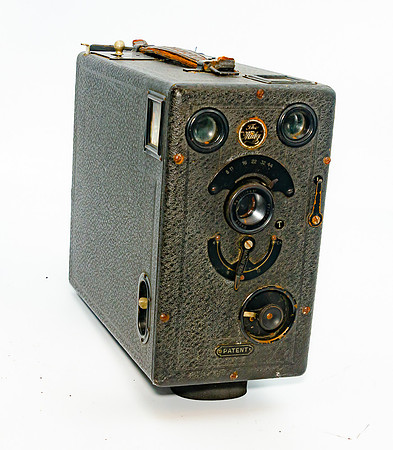
The Butcher Midg No.2 is a British “falling‑plate” magazine hand camera made by W. Butcher & Sons around 1900–1915; it helped make quarter‑plate photography truly portable by combining a 12‑plate magazine, close‑focus options and a compact “detective” body—examples survive in regional museums and specialist collections and are modestly collectible today.
Origins and short history
• Manufacturer: W. Butcher & Sons of London (later part of Houghton/Ensign). Midg models were introduced c.1900 and produced into the 1910s–1920s.
• Market role: Sold as a mid‑range quarter‑plate (3¼ × 4¼ in) hand camera for amateurs and “detective” use; the Midg line was exported (notably to Japan) and advertised widely in the 1904–1911 period.
Key technical features
• Falling‑plate magazine: holds twelve quarter‑plates in metal sheaths; exposed plates either fell out or were replaced by a mechanism—this allowed rapid hand‑held shooting without separate plate holders.
• Lens and shutter: typically fitted with a Rapid Rectilinear or Beck Symmetrical lens and an automatic/everset or adjustable shutter (speeds to about 1/100 s after 1905 revisions).
• Construction: mahogany body, leatherette covering, two brilliant finders, tripod sockets; some variants had folding fronts or rack‑and‑pinion focusing.
Why the Midg No.2 matters
• Portability + magazine convenience: it exemplifies the transition from bulky stand cameras to hand‑held magazine systems that made serious photography more mobile and social.
• Export and influence: the Midg’s presence in overseas catalogues (e.g., Japan) shows early global trade in British amateur cameras and influenced local markets.
Identification and authentication checklist
• Model badge: look for the small round badge marked “The ‘Midg.’” between the viewfinders.
• Magazine mechanism: confirm a 12‑plate falling‑plate magazine with metal sheaths and the original internal guides; mismatched or modern sheet holders indicate modification.
• Lens/shutter markings: Beck or Rapid Rectilinear stamps and an everset/automatic shutter are consistent with No.2 variants.
Collecting, value and where to see one in Auckland
• Collector value: modest—value depends on condition, completeness (sheaths, finders, case) and originality; unrestored working examples are preferred.
• Where to look locally: check Webbs/Thornton estate auctions, specialist camera dealers, and museum holdings (regional museums sometimes hold Midg examples).
Risks and buying tips
• Watch for missing magazine parts, replaced lenses, or heavy refinishing. Test the magazine action and inspect plate sheaths before purchase.