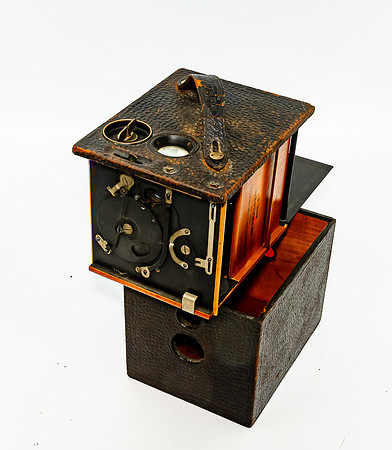
he No. 2 Bulls‑Eye Kodak Model D (c.1900) is a landmark amateur roll‑film box camera introduced from the original Boston Camera design in the 1890s and produced by Eastman Kodak from about 1895–1913; its most important innovation was the use of a red “film‑number” window that made paper‑backed roll film practical for mass‑market snapshot photography. Origins and brief history
Invented by the Boston Camera Manufacturing Company (first shown 1892) and later acquired by Eastman Kodak, the Bulls‑Eye design was adopted and mass‑produced by Kodak after 1895.
Kodak produced the No. 2 Bulls‑Eye family (including Model D) from about 1895 to 1913, with several minor revisions (1896–1898 models, C and D variants). Production totals for the Bulls‑Eye line reached into the hundreds of thousands, making it one of Kodak’s early mass‑market successes.
Key technical features (what made it different)
Format: produced 12 exposures at 3½ × 3½ inches on No.101 paper‑backed roll film—a convenient, portable format for amateurs.
Red film‑number window: the Bulls‑Eye was the first roll‑film camera to use a red viewing window to read frame numbers printed on the paper backing—this simple UI innovation enabled reliable frame advance without a plate‑holder or glass plates.
Construction and optics:wood box body covered in leather, a meniscus achromatic lens with a small set of stops, and a rotary/sector shutter with T and I settings—designed for ease of use rather than high‑end optics.
Cultural and technological importance
Democratized photography. By combining roll film, a simple viewfinder, and the red window, the Bulls‑Eye made snapshot photography accessible, affordable, and portable for non‑specialists—helping shift photography from a specialist craft to a popular pastime.
Influenced Kodak’s business model. The camera exemplified the “camera‑and‑film” consumer model Kodak championed: inexpensive cameras sold with proprietary consumable film, which created recurring revenue and broadened photographic participation.
Where to see and collect
Museum examples: notable institutional holdings include the Collection of Historical Scientific Instruments (Harvard) and the Museum of the History of Science, Oxford, which document the Bulls‑Eye’s design and patent context.
Collector notes: Model D examples are collectible; condition, presence of original case, and working shutter/lens determine value. Early Boston vs. Kodak‑stamped variants are of particular interest to specialists.
Quick takeaway
Why it matters: the No. 2 Bulls‑Eye Model D is historically important because it solved practical problems of roll‑film handling and helped launch mass amateur photography, a cultural shift whose effects persist in how cameras and film (and later digital devices) are marketed and used.