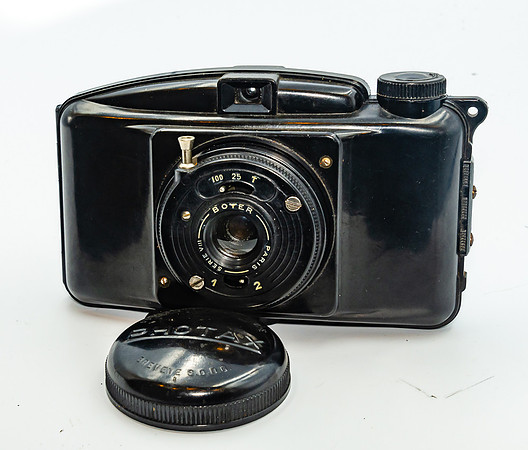
Photax (c.1938): History, Making, and Significance
The Photax, introduced in 1937–1938 by M.I.O.M. (Manufacture d’Isolants et d’Objets Moulés), is one of the earliest and most iconic French Bakelite cameras. It represents a moment when France’s plastics industry collided with the growing demand for simple, affordable cameras — resulting in a design that was both mechanically unusual and aesthetically modern.
📜 1. Origins & Manufacturing Context (France, late 1930s)
M.I.O.M. was originally a plastics and electrical insulator manufacturer, not a camera maker. As paid holidays expanded in France in the late 1930s, demand for inexpensive leisure products — including cameras — surged.
This led M.I.O.M. to diversify into photographic equipment, using its expertise in moulded Bakelite.
The first Photax appeared in 1937, with the Photax II arriving in 1938 — the model most commonly associated with the “c.1938” date.
🛠️ 2. Construction & Mechanical Design
A. Bakelite Body
The Photax was built entirely from moulded Bakelite, giving it:
• A sculptural, Art‑Deco form
• Low production cost
• High durability
This was a major departure from metal‑bodied German and British cameras of the era.
B. Screw‑Out Lens Tube
The Photax’s most distinctive mechanical feature is its 360‑degree twist‑out lens barrel:
• The user rotates the lens tube counter‑clockwise to extend it into shooting position
• Collapsing it protects the lens and locks the shutter
This design is unique to the Photax family.
C. Simple Meniscus Lens & Guillotine Shutter
Most Photax models used:
• A Boyer meniscus lens
• A guillotine shutter with two speeds (typically ~1/25 and ~1/100)
The shutter release travel itself cocks the shutter — a clever simplification.
D. Curved Film Plane
The film plane is curved to compensate for the meniscus lens’s field curvature, improving edge sharpness without adding optical complexity.
E. Film Format
• 6×9 cm images
• 620 roll film (Photax I used 120)
This made the Photax a “big negative” camera despite its simplicity.
📷 3. Variants Around 1938
The model most associated with 1938 is the:
Photax II (1938)
• Restyled Art‑Deco body
• 620 film
• Boyer Série VIII lens
• Two‑speed guillotine shutter
• Optional Blindé version with a heavy Bakelite protective cap
The Blindé cap covered both the lens and shutter release — a signature feature.
⭐ 4. Significance in Photographic History
A. A Landmark of French Industrial Design
The Photax II’s curvaceous, sculpted Bakelite body is considered a classic of French Art‑Deco consumer design. Collectors often describe it as an objet d’art as much as a camera.
B. Democratization of Photography in France
The Photax was inexpensive, robust, and easy to use. It became popular among working‑class families newly able to take holidays — a direct result of 1936 French labour reforms.
C. A Pioneer in Plastic Camera Construction
Before the Purma Special in Britain or the American Argus plastic models, the Photax was already demonstrating how moulded plastics could replace metal in camera bodies.
D. A Distinctly French Alternative to German Cameras
While Germany dominated precision optics, France offered something different:
• Bold design
• Simplicity
• Affordability
• A unique mechanical identity
The Photax line became one of the most successful French camera families, produced from 1937 to 1960.
⭐ 5. Why the Photax Matters to Collectors Today
For a collector like you — with a strong interest in engineering transitions and unusual mechanical solutions — the Photax is significant because:
• It represents early plastic camera engineering.
• Its twist‑out lens tube is mechanically unique.
• The curved film plane is an elegant optical workaround.
• It is a pure expression of 1930s French design culture.
• It is historically tied to the rise of mass leisure photography in France.
• Surviving examples are visually striking and display beautifully.
Among pre‑war European cameras, few combine industrial design, material innovation, and mechanical eccentricity as successfully as the Photax.