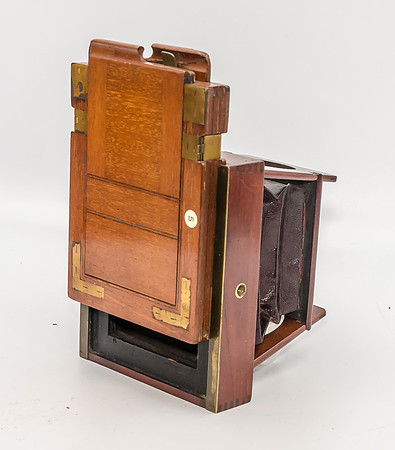
Shew & Co. Eclipse Camera (c.1890)
One of the most innovative British hand cameras of the 1880s–1890s
The Eclipse was a compact, fast‑operating hand camera produced by J. F. Shew & Co., London, a manufacturer active from the mid‑19th century to around 1920.
🧱 1. Construction & Materials
• Spanish mahogany body with brass bindings and fittings.
• Distinctive mauve square‑cornered bellows.
• Compact “shallow body” design with two wing supports holding the lens board under tension.
• This design originated from a patent by Lowdon (1884).
⚙️ 2. Shutter & Lens
Shew’s Central Shutter
• A sector, between‑the‑lens, spring‑powered shutter.
• Typical speeds: 1/30–1/60 sec.
• Considered advanced for its time.
Lenses
• Often fitted with Darlot lenses (f/8 or similar), with wheel stops for aperture control.
• Some models used Ross Goerz Double Anastigmat lenses in later variants.
📐 3. Formats & Variants
The Eclipse line included several models:
Quarter‑plate Eclipse (c.1890)
• 3¼ × 4¼ inch plates.
• Could be fitted with a Rouch patent changing box for 12 plates.
• Included a reflecting viewfinder with celluloid screen.
Roll‑film Eclipse
• Some Eclipse cameras used Eastman‑Walker roll‑holders for darkroom‑loaded roll film.
• Produced 4½ × 6½ inch exposures on roll film.
Long Focus Eclipse (c.1891)
• Longer Darlot lens (approx. 6½").
• Added rack‑and‑pinion focusing and swing/tilt movements on the back.
Focal Plane Eclipse
• High‑end model with focal‑plane shutter offering 1/200–1/1000 sec.
• Larger format: 8½ × 6½ inch plates.
🔍 4. Focusing & Handling
• Helical focusing mount on the lens (unusual for the era).
• Focusing distances varied by model (e.g., 9 ft, 8 ft, or 3½ yards).
• Rising front on many models; long‑focus versions added swing and tilt.
• Reflecting viewfinder with spirit levels for accurate framing.
🧭 5. Historical Significance
• Introduced around 1885 and improved through the 1890s.
• Possibly one of the first British hand cameras with a shallow body and wing‑support lens board.
• Represented a transition from plate field cameras to faster, more spontaneous hand cameras.
• Eventually replaced by the Shew Xit series in the late 1890s.
🏛️ 6. Surviving Examples
• The V&A Museum holds a Shew Eclipse camera dated to the 1890s.
• The Science Museum Group holds a quarter‑plate Eclipse with Eastman‑Walker roll holder (1890).