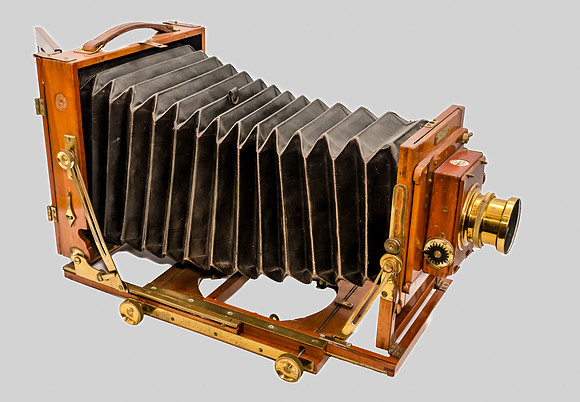
The Thornton‑Pickard Triple‑Extension (often sold as the “Imperial Triple Extension”) is a British field/stand camera prized for its long‑reach front standard and roller‑blind focal‑plane shutter; it was produced from the early 1900s into the 1920s and remains an important example of high‑quality British camera engineering
Origins and production
• Maker: Thornton‑Pickard Manufacturing Co. Ltd., Altrincham, Cheshire, England.
• Period: Introduced c.1904–1913 and produced into the 1920s, with whole‑plate, half‑plate, quarter‑plate and other sizes available.
• Model name: commonly marketed as the “Imperial” triple‑extension (triple brass‑bar front) and offered in both double and triple extension variants.
Key technical features
• Triple‑extension front: three brass bars or rails allow very long extension (up to ~22 in on larger formats) for extreme close‑ups and macro work.
• Roller‑blind (focal‑plane) shutter: Thornton‑Pickard’s patented roller‑blind shutter provided reliable instantaneous speeds and was a signature of the firm.
• Materials and finish: mahogany body, brass fittings, leather bellows and rack‑and‑pinion focusing; interchangeable lenses (Beck, Ensign, Dallmeyer) were common.
Historical importance
• Versatility for field and studio: the triple‑extension combined portability (folding body) with extended focusing range, making it useful for landscape, studio, and scientific close‑up photography.
• Technical influence: Thornton‑Pickard’s shutter and extension designs were widely copied and licensed, influencing British camera manufacture in the early 20th century.
Identification and authentication checklist
• Maker’s stamps: look for “THORNTON / TRIPLE / IMPERIAL / EXTENSION / PICKARD” or similar cast/engraved markings on the front standard or rear.
• Roller‑blind shutter with tassel or pull ring: original T‑P roller blinds often have a tasselled pull and a shutter speed indicator.
• Triple brass bars on the front standard and mahogany body with leather bellows are diagnostic; mismatched parts or modern replacements reduce authenticity.
• Buying tips: check specialist auction houses and camera dealers; verify shutter function, bellows condition, and maker marks. Thornton‑Pickard cameras are collectible but values vary widely by format, condition, and lens.
Quick buying & conservation advice (risks)
• Bellows rot and leather loss are common; expect restoration costs.
• Shutter cloth wear can render the roller‑blind inoperable; test gently and request interior photos before purchase.