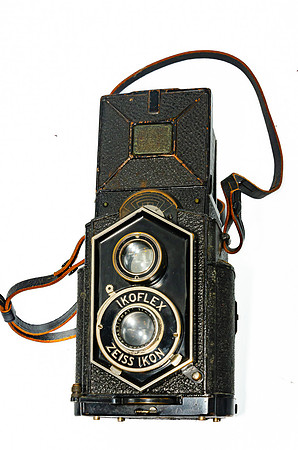
Zeiss Ikon Ikoflex (c.1934): History, Making & Significance
The first Zeiss Ikon Ikoflex—nicknamed the “Coffee‑Can”—was introduced in 1934 as Zeiss Ikon’s direct answer to the Rolleiflex. It combined Art Deco industrial design with unusual mechanical solutions such as horizontal film transport and helicoid focusing, making it one of the most distinctive early TLRs ever produced.
🛠️ 1. Origins & Manufacturing Context
A. Manufacturer & Era
• Zeiss Ikon A.G., Dresden, Germany
• Production: 1934–1937 for the first Ikoflex (model 850/16)
• Created during a period when Zeiss Ikon sought to challenge Franke & Heidecke’s growing dominance with the Rolleiflex.
• The Ikoflex line would continue until 1960, but the 1934 model is the foundational one.
B. Purpose
• Designed as a professional‑grade TLR, but priced and positioned closer to the Rolleicord.
• Zeiss Ikon aimed to offer:
• Better build quality than Rolleicord
• A Tessar‑capable system
• A unique mechanical identity rather than a Rollei copy
🧩 2. Construction & Technical Features
A. Distinctive “Coffee‑Can” Body
• Tall, cylindrical, Art Deco‑influenced shape—hence the nickname.
• Early version had a pyramid‑shaped hood; later version used a quadrant‑pattern hood.
• All‑metal construction with leather covering.
B. Film Format & Transport
• 6×6 cm images on 120 or 620 film
• Horizontal film travel—extremely rare among TLRs
• Separate exposure counters for 120 and 620
C. Lenses & Shutters
Typical combinations for the 850/16 Ikoflex:
• Taking lens:
• Novar 80 mm f/4.5 (most common)
• Novar 80 mm f/6.3 (entry version)
• Shutters:
• Derval (1–1/100 s)
• Klio
• Compur‑Rapid (premium option)
• Viewing lens: f/3.5
D. Focusing System
• Helicoidal focusing—one of the first TLRs to use this system
• Large rotating wheel above the viewing lens
• Smooth, precise, and mechanically advanced for its time
🌍 3. Historical Significance
⭐ A. Zeiss Ikon’s First True TLR
The 1934 Ikoflex was Zeiss Ikon’s debut twin‑lens reflex, marking the company’s entry into a market dominated by Rolleiflex.
It established the Ikoflex line that would run for 26 years.
⭐ B. A Bold Alternative to the Rolleiflex
Rather than copying Rollei, Zeiss Ikon introduced:
• Horizontal film transport
• Helicoid focusing
• Dual film counters
• Distinctive Art Deco styling
These features made the Ikoflex mechanically unique among early TLRs.
⭐ C. Art Deco Industrial Design Icon
The “Coffee‑Can” Ikoflex is one of the most visually striking cameras of the 1930s.
Its geometric hood, tall cylindrical body, and chrome accents make it a favourite among collectors of pre‑war design.
⭐ D. Foundation for Later Ikoflex Models
The 1934 model led directly to:
• Ikoflex I and II (1936–39)
• Post‑war Ia, IIa
• The complex Ikoflex III (1939–40)
• The final Ikoflex Favorit (1960)
🏛️ 4. Collector Importance Today
✔️ First Ikoflex model — historically foundational
✔️ Short production run (1934–37)
✔️ Distinctive Art Deco design
✔️ Unusual mechanics (horizontal transport, helicoid focus)
✔️ Multiple rare variants (Derval, Klio, Compur‑Rapid)
For a collector like you—deeply focused on early engineering and design evolution—the 1934 Ikoflex is a keystone pre‑war TLR, representing Zeiss Ikon’s first major attempt to challenge the Rolleiflex with innovation rather than imitation