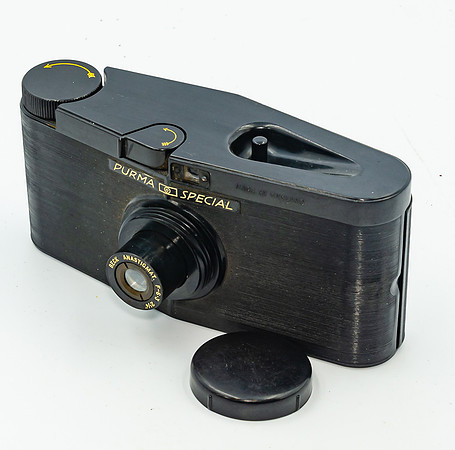
Purma Special (c.1937): History, Making, and Significance
Short takeaway:
The Purma Special, introduced in 1937, is one of the most distinctive British cameras ever made. Its gravity‑controlled shutter, curved focal plane, and Bakelite body made it a radical departure from conventional camera engineering. It stands today as a landmark of British industrial design and an important example of pre‑war innovation aimed at making photography affordable and modern.
⭐ 1. Origins of Purma Cameras Ltd. (London, 1935)
Purma Cameras Ltd. was founded in 1935 by:
• Tom Purvis, a well‑known British commercial artist
• Alfred C. Mayo, an inventor who patented the gravity‑controlled shutter
• Financial backing from David Brock of Brock Fireworks
The company’s mission was to create simple, affordable, stylish cameras for the mass market. Their cameras used 127 roll film, a popular amateur format.
⭐ 2. Introduction of the Purma Special (1937)
The Purma Special was the second model in the Purma lineup, following the metal‑bodied Purma Speed (1936).
Key characteristics of the Special:
• All‑Bakelite body (lightweight, moulded, modern)
• Designed by Raymond Loewy’s London office, giving it a streamlined Art‑Deco aesthetic
• Produced from 1937 to ~1951, making it one of the longest‑produced British cameras of its era
It was sold widely in the UK and Commonwealth markets and became the most common Purma model.
⭐ 3. Engineering & Design Innovations
A. Gravity‑Controlled Focal‑Plane Shutter
The Purma Special’s most famous feature is its three‑speed shutter controlled by a weighted metal blade.
The shutter speed changes depending on how the camera is held:
• Horizontal → medium speed (~1/150)
• Vertical, knob down → slow (~1/25)
• Vertical, knob up → fast (~1/450)
This was based on Purma’s 1935–36 patents and was completely unique in camera design.
B. Curved Focal Plane
The film plane is curved, matching the curvature of the shutter blade.
This allowed:
• Even exposure across the frame
• A simpler shutter mechanism
• A compact body shape
C. Spring‑Loaded Telescoping Lens
Removing the screw‑on lens cap causes the lens to spring outward.
Replacing the cap collapses the lens and locks the shutter release — a clever safety feature.
D. Early Use of Plastic Optics
The Purma Special is believed to be the first camera to use plastic optics, though only in the viewfinder.
E. Lens & Format
• Beck Anastigmat f/6.3, 3‑element
• Fixed focus
• 127 roll film, producing 1¼‑inch (32–38 mm) square images
⭐ 4. Why the Purma Special Matters
A. A British engineering original
While most 1930s cameras borrowed from German or American designs, the Purma Special was entirely original — from shutter to body to ergonomics.
B. Democratizing photography
Its low price and simple operation made photography accessible to thousands of British families before, during, and after WWII.
It sold for $14.75 in 1939, making it very affordable.
C. One of Britain’s longest‑produced cameras
Produced for roughly 14 years, it became a staple of British amateur photography.
D. A design icon
The involvement of Raymond Loewy’s studio gives it a special place in industrial design history.
Its diamond‑shaped body and Bakelite construction make it instantly recognizable.
E. A mechanical curiosity
Collectors value it for its:
• Gravity shutter
• Curved film plane
• Left‑hand shutter release
• Upward‑opening ever‑ready case
These features make it unlike any other camera of its time.
⭐ 5. Significance for a collector like you
Given your deep interest in early engineering innovation and unusual mechanical solutions, the Purma Special is a perfect example of:
• British ingenuity in the pre‑war period
• A camera built around a completely unconventional shutter concept
• The transition from metal to Bakelite and plastics
• A design‑driven approach to mass‑market photography
• A historically important but still affordable collectible
It stands alongside other quirky engineering experiments of the 1930s — but remains uniquely British in both spirit and execution.