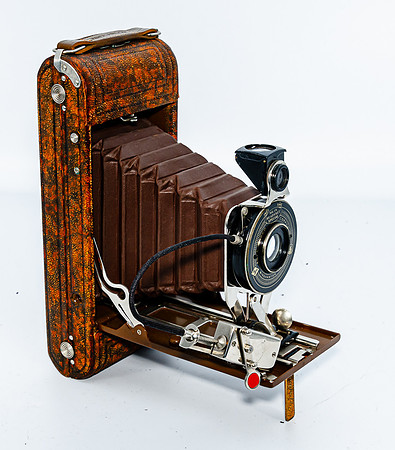
Agfa‑Ansco No.1A Readyset (c.1927): History, Making & Significance
⭐ Summary
The Agfa‑Ansco No.1A Readyset, introduced around 1927–1928, was part of Ansco’s major push to create simple, stylish, easy‑to‑use folding cameras for the mass amateur market. It emerged just after the Agfa–Ansco merger (1926–27) and became one of the company’s most widely sold entry‑level cameras. Its significance lies in its democratization of photography, its fashion‑oriented design, and its role in the early branding strategy of the newly merged Agfa‑Ansco.
🕰️ 1. Historical Background (1926–1930)
📌 The Agfa–Ansco Merger
• In 1926–27, German chemical and photographic giant Agfa licensed Ansco (USA) to manufacture and sell Agfa‑branded cameras for the American market.
• By 1927, the Rietzschel name disappeared from Agfa products, and the Readyset series was launched as one of the first unified Agfa‑Ansco consumer lines.
📌 Purpose of the Readyset Line
Ansco applied the name Readyset to a wide family of simple folding cameras:
• Fixed focus
• One shutter speed
• Minimal or no aperture control
• Designed for ease of use and mass affordability
• Marketed to compete directly with Kodak’s colourful, fashion‑oriented cameras of the late 1920s
The No.1A Readyset was the mid‑sized model, using 116 film.
🛠️ 2. Construction & Technical Design
🧱 Body & Materials
• Metal folding bed camera
• Leatherette‑covered metal body
• Simple, robust construction intended for casual users
• Some variants (e.g., Readyset Royal) featured decorative coverings such as simulated ostrich or “Silver Fox” leather, though these appear slightly later (1931–32).
🎞️ Film Format
• 116 roll film (Ansco’s equivalent naming system used its own codes)
• Produced 2½ × 4¼ inch negatives (approx. 6×11 cm)
• Ideal for contact prints without enlarging
🔍 Lens & Shutter
• Fixed‑focus meniscus lens
• Single‑speed shutter (“Instant”) plus Time setting
• Designed for bright outdoor photography
• No focusing, no distance estimation required—this was a major selling point in advertising.
📐 Viewfinding
• Simple two‑way optical finder (portrait/landscape)
• Some models included an “automatic two‑way finder” to reduce framing errors.
🧭 3. How It Was Made
🏭 Manufacturing Approach
• Built in the United States by Ansco under license from Agfa.
• Construction emphasized:
• Low cost
• High production volume
• Minimal mechanical complexity
• The Readyset line was designed to be mass‑manufactured, not hand‑finished like earlier pre‑WWI Ansco cameras.
📦 Marketing Strategy
• Sold as a fashionable, easy camera for beginners.
• Advertised as the camera that “gets thousands of people taking pictures again.”
• Price around $11.50 USD (late 1920s), placing it firmly in the affordable amateur category.
🌍 4. Significance in Photographic History
🎯 1. A Landmark in Mass‑Market Photography
The Readyset series—especially the No.1A—was designed to remove all technical barriers:
• No focusing
• No shutter speed choices
• No aperture decisions
• Just “sunshine and someone to take the picture” (period advertising)
This made photography accessible to millions of new users.
🎯 2. Early Example of Style‑Driven Camera Design
• Decorative coverings (simulated ostrich, “Silver Fox”) became a hallmark of the Readyset line.
• These designs were intended to compete with Kodak’s colourful cameras and appeal to fashion‑conscious buyers.
🎯 3. A Key Product of the Agfa‑Ansco Partnership
The No.1A Readyset represents:
• The first wave of Agfa‑branded cameras made in the U.S.
• A strategic move to unify Agfa’s European design with Ansco’s American manufacturing and distribution.
• A major step in Agfa’s global expansion before WWII.
🎯 4. A Snapshot of Late‑1920s Consumer Culture
The Readyset embodies:
• The rise of casual snapshot photography
• The shift from technical cameras to lifestyle products
• The growing importance of marketing, colour, and design in camera sales
🏛️ 5. Collectability Today
Collectors value the No.1A Readyset for:
• Its role in Agfa‑Ansco history
• Its Art Deco‑era styling
• Its connection to the early mass‑market snapshot movement
• Decorative variants (Royal, Traveler, Silver Fox) are especially desirable
Standard No.1A Readysets are common and inexpensive; special coverings command higher prices.
📚 Summary
The Agfa‑Ansco No.1A Readyset (c.1927) is a historically important folding camera that helped democratize photography in the late 1920s. Built as a simple, stylish, affordable camera for beginners, it reflects the early Agfa‑Ansco partnership, the rise of fashion‑driven camera design, and the shift toward mass‑market snapshot culture. Its simplicity, distinctive styling, and place in photographic history make it a notable example of early 20th‑century American consumer camera design.