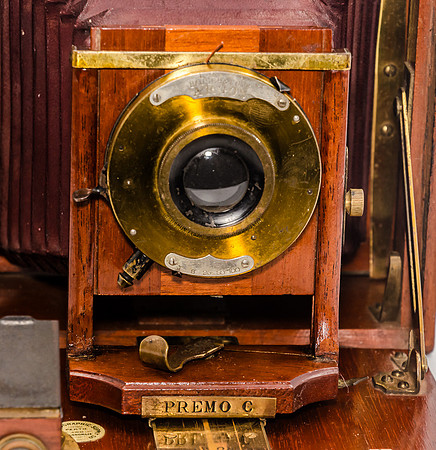
📷 The Premo C Camera (c.1895–1902) The Premo C was produced by the Rochester Optical Company, one of the major American camera makers before being absorbed into Kodak in the early 1900s. It represents a refined, compact plate camera designed for portability and ease of use. ⭐ Key Features
Format options: 4×5" and 5×7"
Lens: Single achromatic or rapid rectilinear
Shutter: “Safety time and instantaneous” shutter, lever‑controlled
These prices positioned it as an affordable but well‑made amateur camera, competing with similar models like the Poco line. 🧭 Historical Context & Significance 🔹 A bridge between field cameras and hand cameras The Premo C was part of a broader trend: making plate cameras more compact, portable, and user‑friendly. While roll‑film cameras were exploding in popularity, many amateurs still preferred the image quality and control of glass plates. 🔹 Mechanical refinement The Premo C’s:
built‑in shutter,
reversible finder,
swing back,
and compact folding design
made it a highly practical field camera for its time—lighter and more convenient than earlier tailboard or sliding‑box designs. 🔹 Part of the Rochester Optical lineage The Premo line was central to Rochester Optical’s identity. By 1897, the company was producing increasingly sophisticated models, including the Reversible Back Premo (a long‑focus variant used even by Edward Curtis). The Premo C sits just below these professional models—a serious amateur’s camera with real capability. 🧩 How the Premo C Fits into the Evolution Timeline The Premo C represents the mature form of the dry‑plate field camera, just before roll‑film cameras fully took over. 🎯 Why the Premo C Matters Today
Collectible: Attractive wood construction, compact size, and good survival rate.
Historically important: Shows the transition from bulky field cameras to portable amateur models.
Technically interesting: Combines movements, ground‑glass focusing, and a built‑in shutter in a small package.