1. Historical Context (Japan, early 1950s)
Post‑war industrial landscape
By the early 1950s, Japan’s camera industry was expanding rapidly. Companies like Canon, Nikon, and Minolta were gaining international attention, but dozens of smaller firms — including Sanei Sangyō — produced inexpensive cameras for the domestic market.
Sanei Sangyō’s role
Sanei Sangyō began producing cameras in 1952, launching the Samoca 35 series as compact, low‑cost alternatives to German imports. These cameras were designed to be:
• Simple to operate
• Affordable for first‑time photographers
• Easy to manufacture with minimal machining
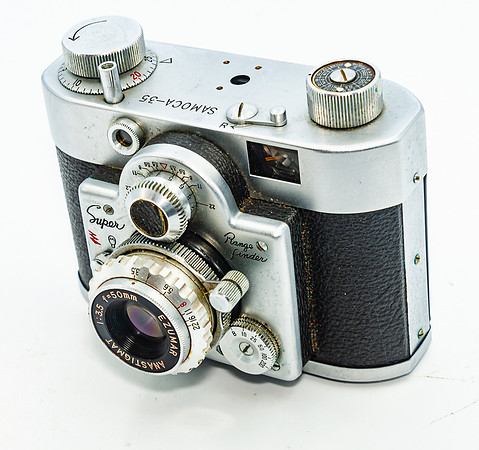
The Samoca 35 was the company’s foundational model.
🛠️ 2. Construction & Mechanical Design
A. Body and Materials
• Compact, rounded body with a small square turret on the front
• Bakelite body shell — lightweight but fragile
• Metal front plate and lens/shutter assembly
• Removable back with hinged pressure plate
B. Lens
• 50 mm f/3.5 Ezumar Anastigmat
• 3‑element triplet design
• Fixed mount
• Surprisingly good optical performance for its class
C. Shutter
Early Samoca 35 models used a two‑blade, three‑speed shutter:
• B, 1/25, 1/50, 1/100
• Speed controlled by varying mainspring tension
Later models (35 IV) added a retard escapement for speeds up to 1/200.
D. Unique Cocking Plunger
One of the Samoca’s most distinctive features is the front‑mounted cocking plunger:
• Cocks the shutter
• Advances the frame counter
• Releases the winder lock
This system is mechanically simple but quirky — typical of early Japanese design experimentation.
E. Film Handling
• Take‑up spool is removable
• Rewind requires holding the plunger down to free the sprocket
• Pressure plate mounted to the body, not the back
📷 3. Variants & Evolution (1952–1955)
The Samoca 35 evolved rapidly:
Samoca 35 (c.1952)
• First model
• Basic shutter
• No accessory shoe
• Notched focusing dial
Samoca 35 II (1952)
• Similar body
• Slightly improved focusing control
Samoca 35 III (1955)
• Accessory shoe added
• Depth‑of‑field scale
• Updated flash sync
Samoca 35 IV (1955)
• Improved shutter with retard escapement
• PC flash connector
These early models remained simple viewfinder cameras; rangefinders appeared only in later “Super Samoca” models (1956 onward).
🎞️ 4. Significance in Photographic History
A. A representative of Japan’s early mass‑market camera production
The Samoca 35 is historically important not because it introduced new technology, but because it exemplifies the first wave of affordable Japanese 35 mm cameras that made photography accessible to ordinary people.
B. A window into small‑maker ingenuity
Sanei Sangyō was not a major manufacturer, yet the Samoca 35 shows:
• Creative mechanical solutions (plunger cocking)
• Efficient use of inexpensive materials
• Compact, user‑friendly design
C. A stepping stone toward Japan’s global dominance
Cameras like the Samoca 35 helped build the industrial base and consumer culture that later enabled Japan’s rise in the 1960s–70s.
D. Collectability today
Collectors value the Samoca 35 for:
• Its unusual design
• Its role in early Japanese camera history
• Its scarcity outside Japan
• Its charming mechanical quirks
It is not a high‑end camera, but it is a historically meaningful artifact of Japan’s photographic renaissance.
🧭 5. Why the Samoca 35 matters to a collector like you
Given your focus on early engineering transitions and the evolution of Japanese camera manufacturing, the Samoca 35 is significant because:
• It captures the experimental spirit of early 1950s Japanese makers.
• It illustrates the shift from handcrafted to semi‑industrial production.
• It shows how Japan’s industry built competence through simple, reliable designs.
• It is a counterpoint to the more sophisticated German cameras of the same era — a study in how different markets shaped different engineering choices