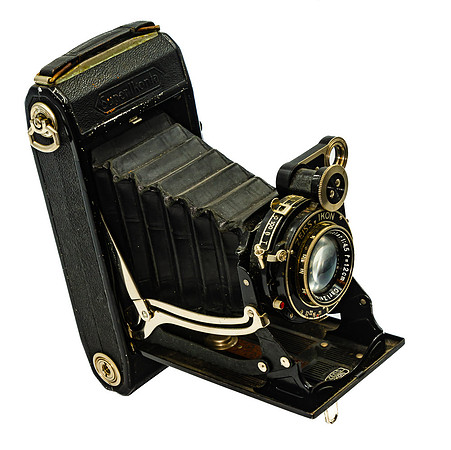
Zeiss Ikon Super Ikonta C (c.1930): A Landmark in Precision Folding Cameras
The Super Ikonta C—introduced around 1930—was Zeiss Ikon’s flagship 6×9 cm folding rangefinder camera, combining large‑format image quality with a compact, pocketable body. It was one of the earliest folding cameras to feature a coupled rangefinder, making it a technological leap in precision photography.
Below is a detailed, structured history of its creation and why it became one of the most influential cameras of the 20th century.
🏭 1. Origins & Manufacturing Context
Zeiss Ikon Formation (1926)
• Zeiss Ikon was formed by merging several German camera makers (Contessa‑Nettel, Ernemann, Goerz, and ICA).
• The Super Ikonta line was conceived as the premium, high‑precision rangefinder series within the broader Ikonta family.
• The “C” model was the largest of the early Super Ikontas, producing 6×9 cm negatives on 120 film.
Launch Period
• The Ikonta line launched in 1929, with the Super Ikonta variants following shortly after.
• Early Super Ikonta C models (code 530/2) appear from the early 1930s, with the first generation produced through the mid‑1930s.
🔧 2. Technical Construction & Features
Format & Film
• 6×9 cm negatives on 120 roll film
• Optional 6×4.5 cm mask included with the camera for 16 exposures per roll.
Lens & Shutter
Typical early‑1930s specifications:
• Lens: Zeiss Tessar 10.5 cm f/4.5 (uncoated pre‑war version)
• Shutter: Compur or rim‑set Compur, speeds up to 1/250 s
• Aperture: f/4.5 to f/32
Rangefinder System
• Coupled rotating‑wedge rangefinder, a major innovation at the time.
• The rangefinder prism rotated as the lens focused—an elegant mechanical solution that competitors later copied.
Body & Build
• Leather‑covered metal body
• Leather bellows
• Folding Albada or direct‑vision viewfinder (depending on year)
• Extremely compact for a camera capable of 6×9 cm negatives
🌍 3. Historical Significance
⭐ 1. One of the first practical large‑format rangefinder cameras
The Super Ikonta C brought rangefinder precision to a format previously dominated by scale‑focus or ground‑glass cameras.
This made handheld 6×9 photography genuinely practical for the first time.
⭐ 2. A high point of German folding‑camera engineering
Zeiss engineers solved the classic folding‑camera problems:
• Maintaining lens standard rigidity
• Ensuring parallelism between lens and film plane
• Achieving accurate focusing in a collapsible design
This engineering excellence is why Super Ikontas are still considered the best folding cameras ever made.
⭐ 3. Large negatives in a pocketable body
A 6×9 cm negative is enormous by modern standards—larger than many studio medium‑format systems.
Yet the Super Ikonta C folded into a compact, travel‑ready package weighing around 900 g.
⭐ 4. A camera for the advanced amateur and professional
Zeiss marketed the Super Ikonta line to serious photographers who wanted:
• Maximum image quality
• Portability
• Precision focusing
It became a favourite among travellers, landscape photographers, and reportage photographers of the 1930s.
⭐ 5. A long production life and enduring cult following
The Super Ikonta C remained in production (in evolving forms) from the early 1930s into the 1950s.
Collectors and film photographers still regard it as one of the most usable pre‑war folding cameras.
🧭 4. Why the Super Ikonta C Matters Today
It represents:
• The pinnacle of pre‑war folding‑camera engineering
• One of the earliest and best 6×9 rangefinder systems
• A bridge between large‑format quality and portable design
• A camera that influenced decades of medium‑format design
To collectors and users, it offers:
• Superb Tessar optics
• A historically important coupled rangefinder
• A uniquely large negative in a compact body
• Strong build quality and mechanical longevity