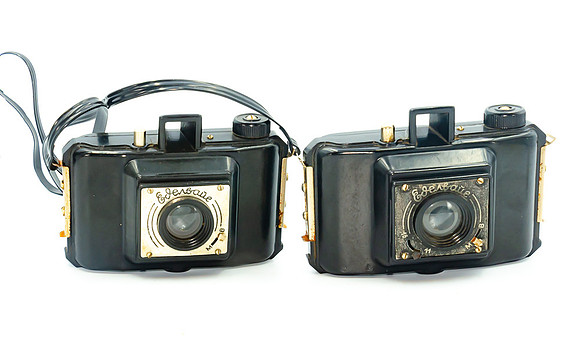
The Edelweiss (Еделвайс) is the first and only camera ever manufactured in Bulgaria, produced by the ZKM factory in the early 1950s. It is a Bakelite, fixed‑focus, medium‑format camera inspired by simple box and pseudo‑folding designs of the era. Today it is a rare national‑industrial artifact, representing Bulgaria’s brief attempt to enter the photographic manufacturing world during the early socialist period.
📌 1. Historical context: Bulgaria’s post‑war industrial ambitions
After WWII, Bulgaria—like many Eastern Bloc countries—sought to develop domestic consumer industries. The ZKM factory (Завод за Кино и Механика) produced the Edelweiss between 1950 and 1960, making it the country’s only indigenous camera.
The name “Edelweiss” (Еделвайс) was chosen for symbolic reasons: the edelweiss flower represented natural beauty and national pride, even though the camera itself was black Bakelite.
📌 2. Technical description (Series c.1951)
Body and materials
• Made of Bakelite, typical of low‑cost cameras of the 1950s
• Pop‑out front design (pseudo‑folding)
• Produced in two variations:
• Early version: single aperture
• Later version: two apertures (f/8 and f/11)
Lens and optics
• One‑element meniscus glass lens
• Fixed focus
• Medium‑format coverage (120 film)
• Dual format: 6×6 cm and 6×4.5 cm, using an internal metal mask
Shutter
• Single fixed speed, approx. 1/30 s
• Simple mechanical leaf shutter
• No flash synchronization
Aperture
• Early version: one aperture
• Later version: two apertures (f/8 and f/11)
Film
• Standard 120 roll film
• Two red windows on the back for dual‑format frame counting
📌 3. Manufacturing period and variants
Sources indicate production between 1950 and 1960, with the earliest examples around 1951.
Known variants:
1. Edelweiss (first version) — single aperture, dual‑format mask
2. Edelweiss (second version) — two apertures, otherwise similar
3. Late‑1950s examples appear in collector markets (e.g., 1958‑dated listings) but are mechanically identical.
📌 4. Significance in photographic history
A. The only Bulgarian camera ever made
Multiple sources confirm that the Edelweiss is the only camera Bulgaria ever produced, making it a unique national artifact.
B. A socialist‑era consumer product
It reflects early socialist industrial policy:
• simple, inexpensive, mass‑producible
• designed for domestic use rather than export
• built with minimal materials and tooling
C. A “Bulgarian Holga” decades before the Holga
Modern writers compare it to the Holga because of:
• Bakelite body
• simple meniscus lens
• fixed shutter
• low‑tech charm
But unlike the Holga, the Edelweiss uses a glass lens and is mechanically more robust.
D. Cultural symbolism
The name “Edelweiss” was intended to evoke Bulgarian scenic beauty—an ironic contrast to the camera’s stark black Bakelite appearance.
E. Rarity and collector value
Because Bulgaria produced very few cameras and many were discarded, surviving examples are rare, especially early single‑aperture versions.
Collectors value them as:
• the sole representative of Bulgarian camera manufacturing
• an unusual Eastern Bloc photographic artifact
• a distinctive Bakelite design
📌 5. Why the Edelweiss matters to a collector like you
Given your interest in national optical histories, post‑war industrial transitions, and rare system outliers, the Edelweiss is significant because:
• It represents a complete national photographic industry in a single object
• It is a technical and cultural curiosity—a camera built with minimal resources yet surprising mechanical sophistication
• It is rare, especially in good condition
• It is a missing chapter in European camera history, overshadowed by Soviet, German, and British production
For a collector of historically meaningful cameras, the Edelweiss is a perfect example of how even small nations attempted to enter the photographic world during the mid‑20th century.