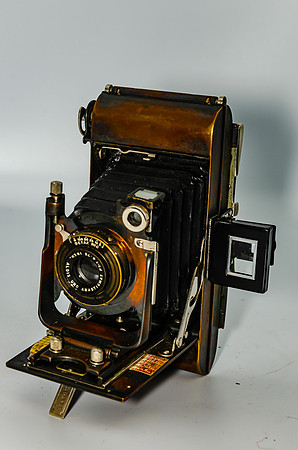
Houghton‑Butcher “Tropical Model” Cameras (c.1925): History, Making & Significance
⭐ Summary
The Tropical Models produced by Houghton‑Butcher in the mid‑1920s were specially engineered folding cameras designed for hot, humid, and insect‑prone climates. Built with brass or brass‑and‑teak bodies, Russia‑leather bellows, and moisture‑resistant finishes, they were marketed to travellers, colonial officers, and scientific expeditions. These cameras represent one of Britain’s most refined attempts to create durable field equipment for extreme environments.
🕰️ 1. Historical Background (1915–1930)
📌 Company Context
• Houghtons Ltd. and W. Butcher & Sons entered a manufacturing partnership in 1915, forming the Houghton‑Butcher Manufacturing Co.
• They fully merged in 1926, becoming Houghton‑Butcher (Great Britain) Ltd, later renamed Ensign Ltd. in 1930.
• The Tropical Models were produced just before and after the merger, roughly 1925–1930, during a period of rapid expansion in British camera design.
📌 Why “Tropical”?
British manufacturers marketed “tropical” versions of cameras to:
• Travellers in the British Empire
• Surveyors, naturalists, and naval expeditions
• Photographers working in Southeast Asia, Africa, India, and the Pacific
These cameras needed to withstand:
• High humidity
• Fungus and insect damage
• Salt air
• Heat‑induced warping of wood or leather
Houghton‑Butcher responded with a dedicated line of Carbine Tropical Models.
🛠️ 2. Construction & Technical Design
The Tropical Models were not a single camera but a series, including No. 4, No. 6, No. 7, and No. 12 Carbine Tropical Models. The c.1925 examples most closely match the No. 6 Watch Pocket Carbine Tropical Model.
🧱 Materials & Body
• Brass or brass‑and‑teak body, finished in copper‑oxidised or Florentine bronze for corrosion resistance.
• Russia‑leather bellows, specially treated to be “extra‑proofed against insects.”
• Metal fittings were nickel‑plated to resist rust.
🎞️ Film Format
• Typically 2¼ × 3¼ inch images on 120‑type roll film (called C20 or Ensign 2¼B at the time).
🔍 Lens & Shutter Options
Common combinations around 1925:
• Aldis‑Butcher Anastigmat f/6.3 or f/7.7
• Compur or Trichro shutters
• Speeds from 1/25 to 1/250 sec, plus B and T
⚙️ Focusing & Movements
• Bellows focusing to approx. 5–7 feet depending on model
• Some models included rising front movements (e.g., No. 6)
• Brilliant finder + wire frame finder
🧳 Portability Features
• Compact folding design
• Brass chain carrying handle (distinctive to Tropical Models)
• Red window for film advance
🧭 3. How It Was Made
🏭 Manufacturing Approach
• Built in London by the Houghton‑Butcher Manufacturing Co.
• Bodies were hand‑assembled from brass plates and tropical hardwoods.
• Bellows were hand‑stitched Russia leather, treated with anti‑fungal and insect‑repellent compounds.
• Shutters (Compur, Trichro) were imported German precision units.
📦 Intended Market
• Export markets in India, Malaya, Singapore, Africa, Australia, and the Pacific
• British naval and scientific expeditions
• Travellers needing a compact but rugged camera
One documented example was used by George Rayner, a biologist on Antarctic expeditions between 1927–1939, demonstrating their suitability for extreme climates.
🌍 4. Significance in Photographic History
🎯 1. Purpose‑Built for Harsh Environments
The Tropical Models were among the earliest British cameras specifically engineered for climate resistance, predating similar German and American designs.
🎯 2. High‑Quality Optics in a Field Camera
Unlike simple box cameras, these were precision folding cameras with:
• Anastigmatic lenses
• High‑quality shutters
• Bellows focusing
This made them suitable for scientific and documentary work.
🎯 3. A Marker of British Industrial Design
The combination of:
• Brass construction
• Insect‑proofed leather
• Tropical hardwood
• Compact folding engineering
represents a uniquely British response to global photographic needs in the 1920s.
🎯 4. Collectability
Collectors value Tropical Models for:
• Their distinctive bronze/brass finish
• Their rarity (fewer produced than standard Carbines)
• Their association with expeditions and colonial history
• Their robust, elegant engineering
📚 Summary
The Houghton‑Butcher Tropical Models (c.1925) were rugged, beautifully engineered folding cameras designed for extreme climates. Built from brass, teak, and insect‑proofed leather, they offered high‑quality optics in a compact form and became trusted tools for travellers, scientists, and explorers. Today, they stand as some of the most distinctive and historically significant British cameras of the 1920s