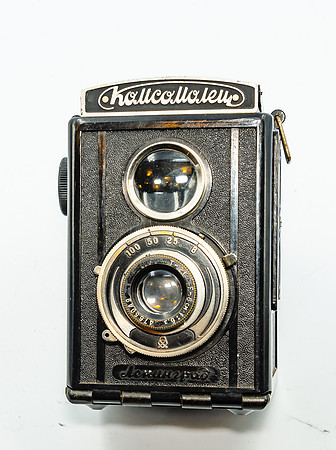
Origins and Manufacturing Context (1946–1948)
After WWII, the Soviet photographic industry needed a simple, affordable camera to restart civilian production. GOMZ adapted the German Voigtländer Brillant pseudo‑TLR design, but rebuilt it entirely with domestic components, making the Komsomolets the first truly post‑war Soviet consumer camera.
Key context for the 1948 period:
• Early 1946–47 units had frame counters and a left‑side red window because Soviet 120 film still used 6×9 markings.
• By 1948, the design had been simplified: most cameras no longer had the unreliable frame counter, and the red window moved to the center.
• Production volume increased dramatically as the USSR pushed to supply youth clubs, schools, and amateur photographers.
Your 1948 camera is almost certainly a Model A type—no frame counter, centered red window, T‑21 6.3/80 lens.
⚙️ Technical Characteristics
1. Pseudo‑TLR Construction
The Komsomolets is not a true focusing TLR:
• Upper lens: viewing only
• Lower lens: taking lens
• Focusing is zone‑based, not through the finder
This simplicity made it cheap and robust.
2. Lens
• Triplet‑21 (T‑21) 80mm f/6.3 on most 1948 units
• A classic 3‑element triplet: moderate sharpness, soft corners, very characteristic rendering
3. Shutter
• Leaf shutter
• 1/25, 1/50, 1/100 + B
• Later 1950 units gained the ZT‑5 shutter with 1/200, but your 1948 example predates this.
4. Film Format
• 120 roll film
• 6×6 cm negatives
• Early units had a 6×9 red window due to film marking limitations
🌍 Historical Significance
1. First Post‑War Soviet Mass‑Production Camera
The Komsomolets was the first camera produced in large numbers after WWII, marking the rebirth of Soviet civilian optical manufacturing.
2. Foundation of the Lubitel Line
Its body design and optical layout directly evolved into the Lubitel (1950) and later Lubitel‑2, which became iconic worldwide.
3. Democratization of Photography in the USSR
It was designed for:
• youth photography clubs
• schools
• amateur photographers
• workers’ cultural centers
It made medium‑format photography accessible to ordinary citizens for the first time.
4. A Transitional Engineering Step
The Komsomolets bridges:
• pre‑war plate cameras (Fotokor‑1)
• early post‑war roll‑film consumer cameras
• later true TLRs like the Lubitel
It represents the shift from heavy, slow plate cameras to compact roll‑film systems.
📈 Collector Significance (Especially for a 1948 Unit)
For a collector with your focus on Soviet engineering evolution, a 1948 Komsomolets is particularly meaningful:
• It sits in the most stable and representative production year.
• Early features (frame counter, left window) were gone, but the camera still retained the original T‑21 lens and early shutter.
• It is part of the first 100,000–150,000 units, before the 1950 redesign.
• Total production was 306,743 units, but early examples are far less common.