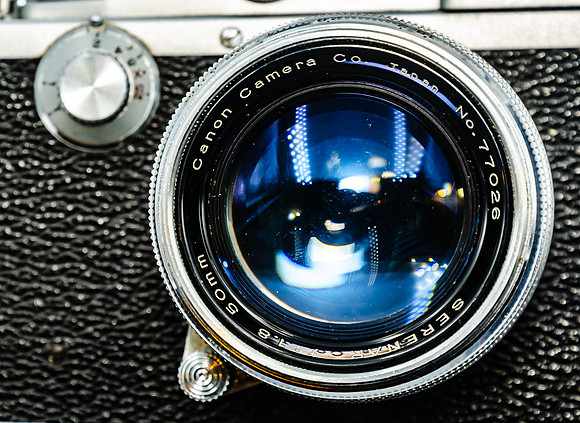
1. Historical Context (Japan, early 1950s)
After WWII, Canon (formerly Seiki Kōgaku) rebuilt its camera division by producing Leica‑type screw‑mount rangefinders. By 1952, Canon had already refined the Barnack‑style body but wanted to surpass Leica in usability and flash capability.
The Canon IV Sb emerged as the successor to the IV S, incorporating a new shutter, improved flash synchronization, and a more polished build. It was marketed globally — especially to U.S. servicemen — and became Canon’s first widely successful export model.
⭐ 2. Manufacturing & Technical Design
A. Production period
• December 1952 – March 1953
• Approx. 34,975 units produced
• First Canon camera offered in black finish (rare and collectible)
B. Lens mount
• Standard M39 Leica Thread Mount (LTM)
• Compatible with Leica lenses
• Canon’s own Serenar lenses (35 mm f/3.5, 50 mm f/1.8, 50 mm f/1.5, etc.) were highly regarded
C. Shutter
• Horizontal‑travel cloth focal‑plane shutter
• 1 s – 1/1000 s + B + T
• Slow speeds on a front dial, fast speeds on the top dial
D. Flash synchronization (its major innovation)
• FP‑sync for flash bulbs
• X‑sync for electronic flash — first camera of its kind to offer this
• Unique side‑mounted flash rail (Canon patent)
E. Viewfinder system
• Combined rangefinder/viewfinder
• Three magnifications selectable via rotating prism:
• 0.67× (50 mm)
• 1× (100 mm)
• 1.5× (critical focusing)
This was a Canon innovation that outperformed Leica’s separate windows.
F. Loading system
• Bottom‑loading, Leica‑style
• Spring‑loaded take‑up spool (often missing today because photographers stole them for their Leicas)
⭐ 3. Why the Canon IV Sb Was Significant
A. First camera with true electronic X‑sync
This made the IV Sb a landmark in flash photography. It allowed photographers to use electronic strobes reliably — a major step toward modern studio and press photography.
B. Canon’s first major success in the U.S.
The IV Sb was the first Canon camera to sell strongly in America, helping establish Canon as a serious competitor to Leica and Nikon.
C. Build quality equal to — or better than — Leica III
Collectors and historians note that Canon’s machining, shutter reliability, and viewfinder ergonomics were at least on par with contemporary Leicas.
D. A turning point in Canon’s evolution
Peter Dechert (Canon historian) ranked the IV Sb as Canon’s second most important early camera, because it represented the moment Canon moved from imitation to innovation.
E. A bridge to later professional Canon rangefinders
The IV Sb directly led to:
• IV Sb2 (1954)
• Canon V series (1956)
• Canon P (1959)
• Canon 7 (1961)
These models eventually challenged Leica’s dominance.
⭐ 4. Collector Significance Today
For a collector like you — with deep interest in engineering transitions and early Japanese innovation — the IV Sb is important because:
• It is the first Canon with X‑sync, a major technical milestone.
• It represents Canon’s breakthrough into the global market.
• It shows Canon’s shift from Leica imitation to original engineering.
• Its three‑magnification finder is one of the best pre‑M‑series rangefinder solutions.
• Black‑finish examples are rare and highly desirable.
• Production numbers were modest, making it collectible but still obtainable.