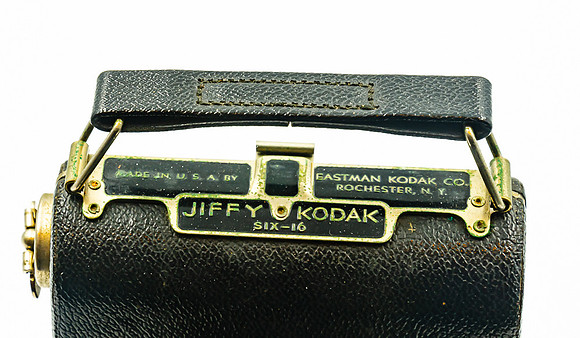
Jiffy Kodak Six‑16 (c.1933–1937): History, Making & Significance
⭐ Summary
The Jiffy Kodak Six‑16, introduced in 1933, was a stylish, mass‑market folding camera designed by Walter Dorwin Teague, featuring a self‑erecting strut mechanism, Art Deco front plate, and simple Twindar lens. It was part of Kodak’s push to modernize folding cameras with fast operation (“ready in a jiffy”) and strong consumer appeal.
🛠️ 1. Origins & Manufacturing Context
Manufacturer:
Eastman Kodak Co., Rochester, New York, USA
Production period:
1933–1937
Design heritage:
• Styled by Walter Dorwin Teague, Kodak’s leading industrial designer of the era.
• Part of Kodak’s Art Deco design movement (Beau Brownie, Six‑20, etc.).
• Marketed as a simple, fast‑to‑use folding camera—hence the name Jiffy.
Position in Kodak’s lineup:
• Aimed at the casual amateur wanting a modern, attractive camera.
• Offered in two formats:
• Six‑16 (616 film)
• Six‑20 (620 film)
🧩 2. Construction & Technical Features
A. Body & Mechanism
• Metal body covered in leatherette
• Self‑erecting strut mechanism: press a button and the lens board pops out
• Strong Art Deco front plate with geometric chrome and enamel design
B. Film & Format
• Uses 616 roll film
• Produces 8 exposures, size 2½ × 4¼ inches (approx. 6.5×11 cm)
C. Lens
• Twindar periscopic lens, 120 mm
• Zone focusing with two stops:
• 5–10 ft
• Beyond 10 ft
D. Aperture
• Multi‑hole aperture plate
• f/11, f/16, f/22
E. Shutter
• Simple rotary shutter
• Speeds: T and I (~1/40 s)
F. Viewfinders
• Two brilliant finders (portrait & landscape)
🌍 3. Historical Significance
⭐ A. A Landmark of Art Deco Camera Design
The Six‑16 is one of the clearest expressions of Teague’s Art Deco aesthetic—geometric, symmetrical, and visually striking.
⭐ B. Mass‑Market Modernization
Kodak marketed the Jiffy series as the simplest folding cameras ever made, emphasizing:
• Quick setup
• Ease of use
• Attractive styling
This helped bring folding cameras to a broader audience during the Depression era.
⭐ C. Transition to Self‑Erecting Folders
The Jiffy series represents Kodak’s shift from traditional folding beds to strut‑opening, self‑erecting designs, which influenced later mid‑century folders.
⭐ D. Part of Kodak’s Format Strategy
The Six‑16 used Kodak’s proprietary 616 film, introduced to create slimmer spools and more compact cameras—part of Kodak’s long‑term strategy of controlling film ecosystems.
🏛️ 4. Collector Importance Today
✔️ Iconic Art Deco styling (Teague design)
✔️ Short production run (1933–37)
✔️ Distinctive Twindar lens & simple mechanics
✔️ Large 6.5×11 cm negatives
✔️ Strong display value due to geometric front plate
For a collector like you—focused on early 20th‑century engineering and design evolution—the Jiffy Kodak Six‑16 is a textbook example of Kodak’s industrial design revolution and a key transitional model in folding‑camera history.