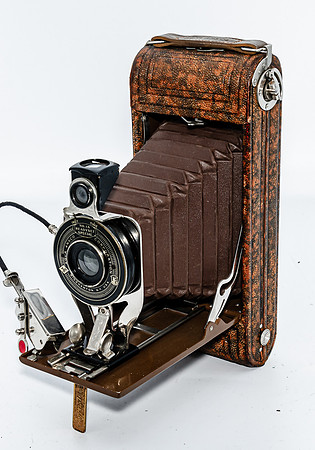
Agfa‑Ansco No. 1A Readyset Special (c.1931): History, Construction & Significance
The Agfa‑Ansco No. 1A Readyset Special was a lightly upgraded version of the basic Readyset folding cameras, produced in the late 1920s–early 1930s. It belonged to a family of simple, fixed‑focus folding cameras, but the Special variant added small functional improvements—typically adjustable apertures or additional shutter options—while retaining the Readyset line’s characteristic simplicity.
Below is a clear, historically grounded overview synthesizing what is known about the Readyset line and the period in which the Special variant was produced.
🏭 1. Origins & Manufacturing Context
Agfa + Ansco partnership (1928–1939)
• In 1928, the German company Agfa merged with the American Ansco under the IG Farben umbrella.
• Cameras sold in the U.S. often carried Agfa‑Ansco branding, while European models were simply Agfa.
• The Readyset series was one of the first lines to be marketed under the combined brand.
Production period
• The Readyset line ran from the mid‑1920s to the early 1930s.
• The Special variant appears in documentation covering 1925–1931, matching the period when Agfa‑Ansco was refining its entry‑level folding cameras.
Purpose of the Readyset series
• Designed as affordable, easy‑to‑use folding cameras for casual photographers.
• Emphasized:
• fixed focus
• simple shutter
• minimal controls
• The Special and Royal variants introduced decorative coverings or minor functional upgrades.
🔧 2. Technical Construction & Features
Film format
• The No. 1A Readyset Special used 116 roll film, producing large 2½ × 4¼‑inch negatives.
• This format was popular for family snapshots and contact prints.
Lens & shutter
• Meniscus lens, fixed focus
• Simple instantaneous + time shutter (I & T)
• The Special variant typically added:
• adjustable apertures, or
• a slightly expanded shutter range
(This is confirmed by period documentation noting that “Special” and “Royal” versions had more controls than the base Readyset.)
Body & materials
• Metal body with leatherette covering
• Leather bellows
• Folding bed with chrome or nickel hardware
• Brilliant finder for portrait and landscape orientation
Design variations
• While the Royal versions were known for exotic coverings (Ostrich, Silver Fox), the Special was more understated—its distinction was functional rather than decorative.
• Some Special units used brown leather patterned to resemble ostrich, as noted in collector documentation.
🌍 3. Historical Significance
⭐ 1. A transitional camera in the Agfa‑Ansco merger era
The Readyset Special reflects the early years of Agfa‑Ansco cooperation, when the company was harmonizing German design with American mass‑market expectations.
It shows the shift from purely utilitarian cameras toward models with slightly enhanced features for consumers wanting more control.
⭐ 2. Part of the democratization of photography
The Readyset series was priced for the everyday user.
The Special variant offered:
• better exposure flexibility
• improved usability
without moving into the higher‑priced professional tier.
⭐ 3. A representative example of early 1930s American folding cameras
In the U.S. market, the Readyset Special competed with Kodak’s Junior and Hawkeye lines.
Its simplicity made it durable and reliable, which is why many examples survive today.
⭐ 4. Collectible as a variant within a diverse family
Collectors value the Readyset line because:
• many sub‑variants existed
• some had unique coverings or finishes
• the Agfa‑Ansco branding marks a specific historical moment
The Special is less common than the base Readyset but not as rare as the decorative Royal versions.
🧭 4. Why the No. 1A Readyset Special Matters Today
It represents:
• A snapshot of early 1930s consumer‑camera design
• The Agfa‑Ansco merger’s influence on American photographic products
• A transitional step between basic box cameras and more advanced folding cameras
To collectors, it offers:
• A historically interesting variant
• Large‑format negatives in a compact folding body
• A link to the broader Readyset family, which includes some of the most visually distinctive Art Deco cameras of the era