Origins and Historical Context
Carl Zeiss Jena after WWII
After 1945, the Zeiss factory in Jena found itself in the Soviet occupation zone.
• Many engineers were taken to the West (Oberkochen).
• The remaining team had to rebuild production under the new GDR state economy.
• They needed a camera that was simple, modern, exportable, and uniquely East German.
The result was the Werra, named after the river flowing through the town of Eisfeld, where production began in 1954.
Why the Werra existed
The GDR needed:
• a camera for domestic use,
• a product for export to earn hard currency,
• a design that did not infringe on Western patents.
Thus, the Werra was deliberately not a Leica copy, nor a Contax derivative.
It was a clean-sheet design, created by Zeiss engineers who were also amateur photographers.
2. Design and Construction
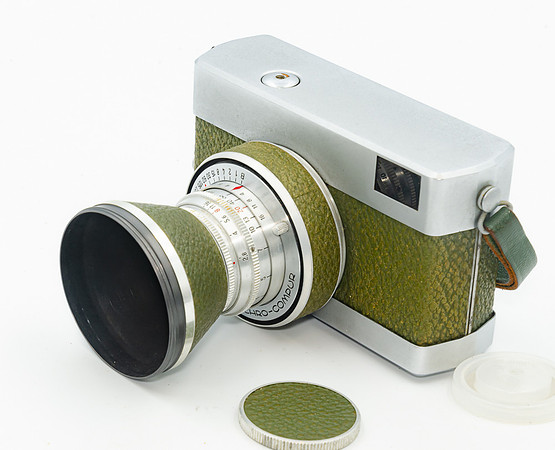
Minimalist Bauhaus-inspired form
The Werra I is famous for its:
• cylindrical body,
• smooth leatherette wrap with no protrusions,
• absence of a top-mounted advance lever,
• symmetrical, balanced aesthetic.
It looks more like a piece of industrial sculpture than a camera.
Unique mechanical features
• Film advance ring around the lens — rotate the front ring to cock the shutter and advance film.
• Integrated lens cap that doubles as a yellow filter (a brilliant piece of functional design).
• Central leaf shutter (Prontor or Prestor type) with speeds typically 1/25–1/250.
• Tessar 50mm f/2.8 or Novonar 50mm f/3.5 lens.
• No rangefinder on Werra I — it is a scale-focus camera.
• Top plate is extremely clean: only shutter release and frame counter.
Build quality
Despite being a socialist-era product, the Werra I is:
• precisely machined,
• beautifully finished,
• mechanically elegant.
It is one of the few GDR cameras that can be called truly premium.
3. Evolution of the Werra Line
The Werra I (1954–1957) was the base model.
Later models added:
• Werra II — rangefinder
• Werra III — rangefinder + exposure meter
• Werra IV/V — interchangeable lenses
• Werra Mat — selenium meter in a unique rotating housing
But the Werra I remains the purest expression of the original design philosophy.
4. Significance
1. A symbol of East German industrial design
The Werra is often cited in design history books as:
• the most elegant camera ever produced in the Eastern Bloc,
• a rare example of socialist minimalism,
• a product that could compete aesthetically with Western brands.
It is sometimes compared to:
• Braun appliances by Dieter Rams,
• early Bauhaus metalwork,
• Scandinavian functionalism.
2. A unique mechanical concept
The film-advance ring is one of the most unusual solutions in 35mm camera history.
It:
• eliminates the need for a lever,
• keeps the body smooth,
• creates a distinctive shooting rhythm.
No other major manufacturer adopted this system.
3. A political and cultural artifact
The Werra embodies:
• the optimism of early GDR industrial policy,
• the desire to create a “socialist modernity”,
• the tension between tradition (Zeiss optics) and innovation (new body design).
It is a camera with ideological weight, not just technical interest.
4. Collector value
Collectors appreciate the Werra I for:
• its iconic design,
• its mechanical simplicity,
• its historical symbolism,
• its display value (it looks stunning on a shelf).
It is not rare, but highly desirable among design-focused collectors.
5. Why the Werra I Matters Today
The Werra I is significant because it represents:
• a break from Leica/Contax copying,
• a bold, original design language,
• a fusion of Zeiss optical quality with socialist-era creativity,
• a camera that is both functional and sculptural.
It is one of the few mid‑century cameras that can be appreciated equally by:
• photographers,
• industrial designers,
• historians,
• collectors.
Summary
The Werra I (c.1955) is a masterpiece of East German design:
• minimalist,
• innovative,
• mechanically elegant,
• culturally symbolic.
It stands apart from all other 1950s cameras and remains one of the most distinctive photographic instruments ever made.