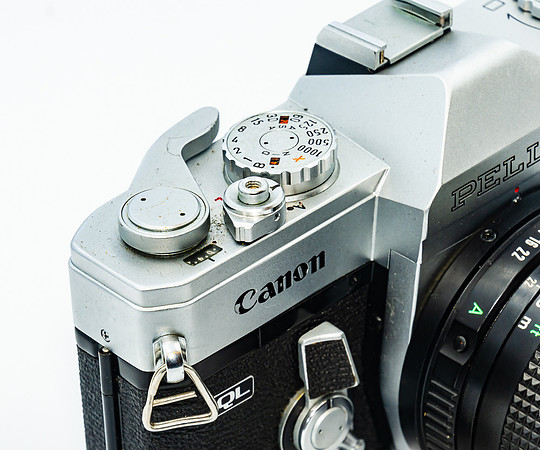
Origins and Manufacturing Context
Canon in the mid‑1960s
By 1964–1966, Canon was reinventing its SLR strategy.
The company had just abandoned the Canonflex line and introduced the FL mount, aiming to compete with Nikon, Minolta, and Pentax.
The original Canon Pellix appeared in 1965 as Canon’s first TTL‑metered SLR.
The Pellix QL, released in March 1966, refined the design with:
• Quick Load (QL) film system,
• improved stop‑down lever with lock,
• contacts for the optional Canon Meter Booster for low‑light metering.
This was Canon’s attempt to leapfrog competitors through innovation rather than imitation.
🔧 2. Technical Design and Construction
The Pellicle Mirror
The Pellix uses a 20/1000 mm ultra‑thin Mylar pellicle mirror, permanently fixed in place.
It splits incoming light:
• ~2/3 to the film,
• ~1/3 to the viewfinder.
Advantages:
• No viewfinder blackout during exposure.
• No mirror slap → reduced vibration.
• Quieter operation.
• Allows lenses with rear elements extending deeper into the body.
Trade‑offs:
• Dimmer viewfinder.
• Slight loss of light to the film.
• Pellicle surface is delicate and difficult to clean.
Other Key Features
• Shutter: horizontal cloth focal‑plane, 1–1/1000 s + B.
• Metering: TTL stop‑down CdS match‑needle system.
• Lens mount: Canon FL breech‑lock.
• Viewfinder: fixed pentaprism, 0.9× magnification.
• Film loading: Canon’s excellent Quick Load system.
Lenses
Canon offered special optics for the Pellix:
• FLP 38 mm f/2.8 compact Tessar‑type lens (exclusive to Pellix).
• FL 58 mm f/1.2 to compensate for light loss.
• FL 50 mm f/1.4 II, a lens that became the basis for the later FD optical line.
🌍 3. Significance in Photographic History
A. The first practical pellicle‑mirror SLR
While pellicle mirrors existed conceptually, Canon was the first to put one into mass‑market production.
This made the Pellix a landmark in SLR engineering.
B. A precursor to high‑speed professional cameras
The pellicle concept later reappeared in:
• Canon F‑1 High Speed Motor Drive,
• EOS RT,
• EOS‑1N RS.
These cameras used the same principle to achieve extremely high frame rates without mirror blackout.
C. A bold but commercially limited experiment
The Pellix QL was admired for innovation but:
• the dim viewfinder,
• delicate mirror,
• and rapid evolution of conventional SLRs
meant it was produced only for a few years (1966–1970).
D. Canon’s transition to modern SLR dominance
The Pellix sits at a pivotal moment:
• after the Canonflex era,
• before the FTb, F‑1, and FD‑mount revolution.
It represents Canon’s willingness to experiment aggressively—an attitude that later helped them overtake Nikon in the autofocus era.
🎞️ 4. Collectability and Legacy
Why collectors value the Pellix QL:
• Unique engineering—no other mainstream SLR works quite like it.
• Historical importance as Canon’s first TTL SLR with a radical mirror design.
• Short production run, increasing rarity.
• Association with later high‑speed Canon pro bodies.
• Distinctive shooting experience with no blackout.
Market notes
• Bodies often remain functional, but pellicle mirrors may degrade.
• FL lenses are affordable and optically excellent.
• Complete kits with the FLP 38/2.8 or FL 58/1.2 are especially desirable.
🧭 5. Why this camera matters in your collecting framework
Given your deep interest in engineering transitions, optical innovation, and historically significant design, the Pellix QL is a perfect fit. It represents:
• a radical departure from conventional SLR mechanics,
• Canon’s early mastery of TTL metering,
• a technological dead‑end that still influenced future pro cameras,
• and a snapshot of 1960s Japanese innovation culture.
It’s one of those cameras that tells a story simply by existing.