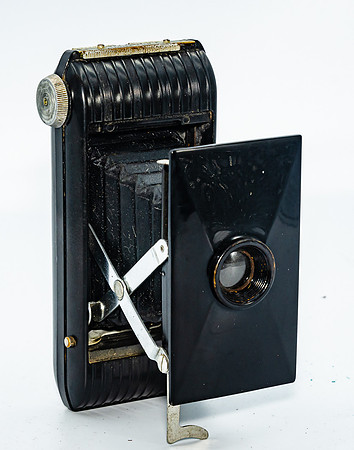
Kodak Jiffy V.P. (1935): History, Making, and Significance
1. Origins and Manufacturing Context (1935–1942)
The Kodak Jiffy V.P. was introduced in 1935 and produced until 1942, during the height of the Art Deco / Streamline Moderne design era. It was manufactured by Eastman Kodak as part of their push to create affordable, stylish, compact cameras for the mass amateur market.
It was designed by the celebrated industrial designer Walter Dorwin Teague, who shaped many of Kodak’s most iconic Art Deco products.
Key manufacturing characteristics
• Body material: Molded Bakelite, one of the earliest plastics, allowing mass production and modern styling.
• Film type: 127 roll film, producing 8 exposures of 6×4.5 cm.
• Market position: A compact, inexpensive alternative to the larger Jiffy Six‑20 and Six‑16 models.
• Price at introduction: US $5.00, making it accessible to the broad middle class.
2. Technical Design and Features
Optics & Shutter
• Lens: Fixed‑focus doublet.
• Shutter: Everset shutter with instantaneous and B settings.
• Aperture: Two‑position slider: “large” and “small” aperture.
• Accessories:
• Portrait Attachment No. 13 (close‑up lens).
• Diffusion Portrait Attachment No. 13 (soft‑focus effect).
These attachments expanded the camera’s creative capability despite its simplicity.
Body & Ergonomics
• Compact folding design with chrome struts.
• Two shutter release buttons for both portrait and landscape orientation.
• Folding brace for tabletop stability.
• Streamline Moderne styling with horizontal stripes and geometric forms.
This aesthetic is noted in multiple sources as a hallmark of Teague’s design language.
3. Historical Significance
A. A milestone in Art Deco industrial design
The Jiffy V.P. is one of the clearest examples of Walter Dorwin Teague’s Art Deco influence on Kodak’s consumer products.
• Its Bakelite body, geometric lines, and compact form made it a design icon.
• It paralleled other Teague designs such as the Beau Brownie and Bullet cameras.
B. Democratization of photography
Priced at only $5, the Jiffy V.P. made photography accessible to millions during the late Depression era.
• Its simple operation (fixed focus, two apertures, two shutter speeds) meant anyone could use it.
• It was marketed as a family camera, ideal for travel, holidays, and everyday snapshots.
C. A compact evolution of Kodak’s folding camera tradition
Compared to the earlier Jiffy Six‑20, the V.P. was:
• Smaller,
• Lighter,
• More portable,
• And designed specifically for the 127 Vest Pocket format, which had been popular since WWI.
D. A bridge between pre‑war and wartime photography
Produced until 1942, the Jiffy V.P. spans the period just before the U.S. entered WWII.
• Its Bakelite construction and simple mechanics made it durable and reliable.
• Many examples were used by families documenting the pre‑war and wartime home front.
4. Collector Significance Today
For a collector like you—focused on design evolution, manufacturing history, and technical transitions—the Jiffy V.P. is important because:
Why it matters
• It is one of the purest Art Deco cameras ever mass‑produced.
• It represents Kodak’s shift to plastics and modern industrial design.
• It is a compact folding camera—a rare combination.
• It is part of the Teague design lineage, making it historically and aesthetically significant.
• Surviving examples often retain their distinctive styling, making them visually striking display pieces.
Rarity & Variants
• Produced in large numbers, but mint examples with original box are highly collectible.
• Variations in shutter plate markings and minor cosmetic differences exist across the 1935–42 production run.