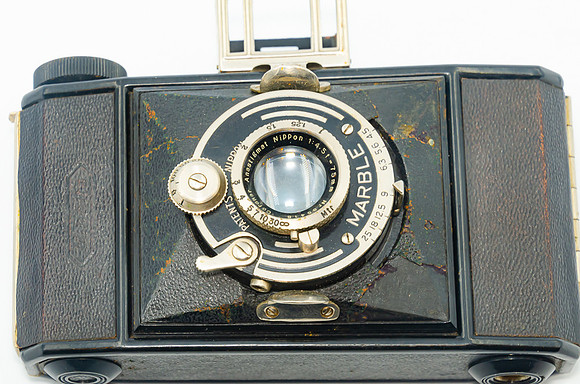
Minolta Vest “Marble” (c.1934–1935): History, Making & Significance
The Minolta Vest Marble is one of the very first cameras ever sold under the Minolta name, produced in 1934–35 by Molta (later Minolta). It is historically important as an early Japanese Bakelite camera, a pioneering collapsible design using telescoping plastic “bellows,” and a key step in Japan’s emergence as a camera‑manufacturing nation.
🛠️ 1. Origins & Manufacturing Context
Manufacturer:
• Molta Camera Co., Osaka — renamed Minolta in 1931
• Distributed by Asanuma Shōkai in Japan
Production period:
• 1934 to early 1940s, with the Marble being the first series (1934–35)
• Some early serials (e.g., #3705) may be pre‑series 1933 prototypes.
Historical setting:
• Japan’s camera industry was still young; Minolta was competing with German imports.
• The Vest Marble was one of the first Japanese cameras made largely of plastic, a bold industrial experiment.
• The name “Marble” refers to the three‑speed shutter whose name was printed on the front — leading collectors to mistakenly call the camera itself “Marble.”
🧩 2. Construction & Technical Features
A. Body & Materials
• Entirely Bakelite body, reinforced with tissue and wire for strength.
• Three telescoping Bakelite boxes extend the lens — functioning as “plastic bellows.”
• This design was conceived by Ehira Nobujirō, later founder of Ehira Camera Co.
• Bakelite was chosen partly due to shortages of natural leather in East Asia.
B. Film Format
• Uses 127 roll film
• Produces 4×6.5 cm or 3×4 cm images (with internal mask).
C. Lens & Shutter
• Fixed‑focus lens, early models only f/8
• Later Marble/Vest versions introduced f/5.6 and f/4.5 options
• Marble shutter:
• Speeds 1/25, 1/50, 1/100, plus B and T
• Very simple but reliable design for the era
D. Viewfinder & Operation
• Folding frame finder with markings for both formats
• Two red windows on the back for film advance
• Collapsible front plate with metal spring latch
🌍 3. Historical Significance
⭐ A. One of the First Cameras Sold Under the Minolta Name
Experts consider the Vest Marble either the first or second officially Minolta‑branded camera.
This makes it a cornerstone of Minolta’s corporate identity.
⭐ B. Pioneering Use of Bakelite in Japanese Cameras
At a time when most cameras used leather bellows and metal bodies, the Vest Marble’s plastic telescoping bellows were radically innovative.
This design later influenced the Minolta Six (1935).
⭐ C. A Key Step in Japan’s Pre‑War Camera Industry
The Vest Marble helped establish Japan as a serious camera‑producing nation, offering a domestic alternative to German Vest Pocket cameras.
⭐ D. Compact, Affordable, and Mass‑Market
The camera was designed to be:
• Small
• Inexpensive
• Easy to use
This made photography more accessible in 1930s Japan.
⭐ E. Rare Early Serial Variants
Early serial numbers (below #4200) may represent 1933 pre‑production units, making them highly collectible.
🏛️ 4. Collector Importance Today
✔️ Foundational Minolta model — essential for any Minolta history collection
✔️ Rare early Bakelite construction — fragile, so few survive intact
✔️ Distinctive telescoping “plastic bellows” — unique in camera history
✔️ Short early production window (1934–35)
✔️ High display value due to Art Deco styling and unusual materials
For a collector like you—focused on early engineering and design evolution—the Minolta Vest Marble is a keystone Japanese camera, representing the birth of Minolta’s design language and Japan’s early industrial innovation.