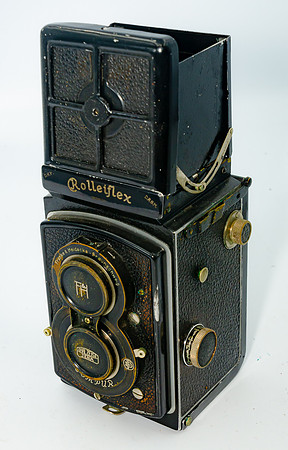
The Rolleiflex Old Standard (c.1934) represents the moment when Franke & Heidecke perfected the early twin‑lens reflex formula—introducing rapid film advance, top‑viewable controls, and a die‑cast body that defined the professional TLR for the next decade. It is the camera that transformed the Rolleiflex from an innovative idea into the world’s most influential roll‑film TLR.
Below is a structured, collector‑grade history tailored to your interest in early 20th‑century engineering.
📷 Rolleiflex “Old Standard” (c.1932–1938): History, Making & Significance
🛠️ 1. Origins and Manufacturing Context
• Manufacturer: Franke & Heidecke, Braunschweig, Germany
• Production era: Introduced 1932, widely used through 1934–1938
• Predecessor: The Original Rolleiflex (1929), which used 117 film and had knob wind and manually cocked shutter.
• Why “Old Standard”?
The name was applied retrospectively after the major redesign of 1939; all pre‑1939 “Standard” models became known as Old Standard.
The Old Standard was the camera that established the Rolleiflex as a professional tool rather than a niche experiment.
🧩 2. Construction & Mechanical Innovations
A. Die‑Cast Zinc Body
• Built around a die‑cast zinc shell, a relatively new industrial process in the early 1930s.
• Provided dimensional stability, rigidity, and repeatability—critical for precise TLR alignment.
• Castings were then machined, painted in multiple finishes, and selectively polished to reveal raised metal decoration.
B. Rapid Film Advance (No Red Window)
• A single‑stroke lever advanced the film and positioned the next frame without needing to check a red window.
• This was a major leap over earlier roll‑film cameras and a key reason professionals adopted the Rolleiflex.
C. Viewing & Control Layout
• Left‑hand focusing, allowing the right hand to operate the shutter and film advance.
• Top‑viewable shutter and aperture scales, readable from the photographer’s position—an ergonomic breakthrough.
• Rim‑set Compur shutter, manually cocked on the Old Standard (full automation came later).
D. Optics
• Typically fitted with Zeiss Tessar 75 mm f/3.8 or f/4.5 (uncoated).
• The Tessar’s sharpness and contrast helped cement the Rolleiflex’s reputation among press and fashion photographers.
🌍 3. Historical Significance
⭐ A. The First Truly Modern Professional TLR
The Old Standard refined the TLR concept into a fast, reliable, ergonomic system camera.
It introduced:
• Rapid lever advance
• Top‑readable controls
• Die‑cast precision body
These features made it the first TLR that professionals could use instinctively and quickly.
⭐ B. A Camera That Defined the Rolleiflex Identity
The 1932–1938 Old Standard established the Rolleiflex “look” and operating philosophy that continued through the Automat, 2.8F, and beyond.
It became the signature product of Franke & Heidecke.
⭐ C. A Workhorse for Press, Fashion & Documentary Photography
The Rolleiflex’s bright viewing screen, leaf shutter (flash at any speed), and compact 6×6 format made it ideal for:
• Press photographers
• Sports photographers
• Fashion and portrait work
Its handling speed was unmatched by plate cameras still common in the early 1930s.
⭐ D. A Bridge Between Early TLRs and the Automat Era
The Old Standard sits between:
• The Original Rolleiflex (1929) — knob wind, red window
• The Automat (1937) — automatic frame counting, fully integrated shutter cocking
It represents the transitional moment when the TLR became a professional standard.
🏛️ 4. Collector Importance Today
✔️ Historically pivotal — the model that made the Rolleiflex a global professional tool
✔️ Early die‑cast construction — important in camera manufacturing history
✔️ Classic Tessar optics — signature 1930s rendering
✔️ Distinctive pre‑Automat ergonomics — pure mechanical elegance
✔️ Strong collector demand — especially for clean examples with original leather and bright screens
For a collector like you—focused on early engineering evolution—the Old Standard is essential: it is the camera where the Rolleiflex becomes the Rolleiflex.
📌 Summary
The Rolleiflex Old Standard (c.1934) is the definitive early professional TLR, combining die‑cast precision, rapid film advance, and ergonomic innovations that shaped all later Rolleiflex models. Its influence on professional photography and camera design is profound, making it one of the most important cameras of the 1930s.