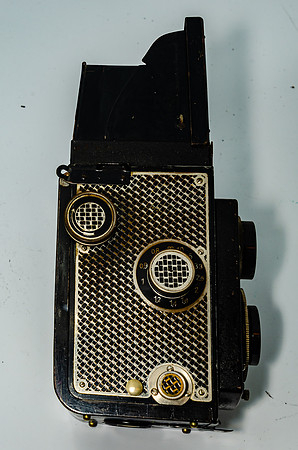
Rolleicord I Art Deco (c.1935)
History, Manufacturing, and Significance
🏭 1. Origins & Production Context
• Produced by Franke & Heidecke (Rollei) from November 1933 to March 1936.
• It was the first Rolleicord model, created as a more affordable, simplified version of the Rolleiflex for advanced amateurs.
• Approximately 32,508 units of the Art Deco Model 1 (factory code K3‑510) were built.
• Manufactured in Braunschweig, Germany, during a period when Rollei was rapidly expanding its TLR lineup and establishing itself as a leader in precision camera engineering.
🎨 2. Art Deco Industrial Design
The Rolleicord Art Deco is one of the most visually distinctive cameras of the 1930s.
Key design features
• Nickel‑plated body with a trompe‑l’oeil geometric grid on the front, sides, and top—hence the German nickname “Tapeten‑Rolleicord” (“wallpaper Rolleicord”).
• Elaborately patterned wind, focus, and spool knobs.
• Early examples carry DRP and DRGM markings, indicating pre‑WWII German patent and design protection.
This decorative metalwork places the camera firmly within the high Art Deco period, making it one of the most collectible Rollei designs ever produced.
🔧 3. Technical Construction
Lenses
• Taking lens: Zeiss Jena Triotar 75 mm f/4.5, 3‑element design.
• Viewing lens: Heidoskop/Heidoscop 75 mm f/4.
Shutter
• Compur leaf shutter, speeds 1 s to 1/300 s, plus B and T.
Film & Format
• Uses 120 roll film, producing 6×6 cm images.
• Manual knob wind (no crank), with red‑window start and mechanical frame counter.
Body & Viewing
• Metal TLR body with waist‑level finder, ground‑glass focusing screen, and parallax‑adjustable hood.
🧩 4. Historical Significance
A. First Rolleicord Model
The Art Deco version represents the birth of the Rolleicord line, which would run until 1976. It established Rollei’s strategy of offering a high‑quality but more affordable TLR for serious amateurs.
B. Art Deco Masterpiece
Among all Rollei cameras, the Art Deco Rolleicord is the only model with such elaborate patterned metalwork, making it a standout example of 1930s industrial design. Collectors prize it for its aesthetic rarity.
C. Engineering Bridge to the Rolleiflex
It shares Rollei’s core TLR architecture—dual lenses, precision shutter, waist‑level viewing—but with simplified mechanics (knob wind, Triotar lens). This made advanced TLR photography accessible to a broader audience.
D. Pre‑war German Craftsmanship
The DRP/DRGM markings and nickel‑plated construction place it firmly in the pre‑WWII German engineering tradition, a period of exceptional mechanical quality.
🏆 5. Collector Importance
For a collector like you—focused on early engineering and design evolution—the Rolleicord Art Deco is significant because:
• It is the earliest Rolleicord, foundational to Rollei’s amateur TLR lineage.
• Its Art Deco faceplates are unique in the entire Rollei catalog.
• Production numbers were modest, and surviving examples with clean plating and intact patterning are scarce.
• It represents a rare intersection of functional precision and decorative industrial art.
Current market (2024–2025)
• Good condition: USD $200–$350
• Excellent: USD $350–$550
• Mint: USD $550–$900