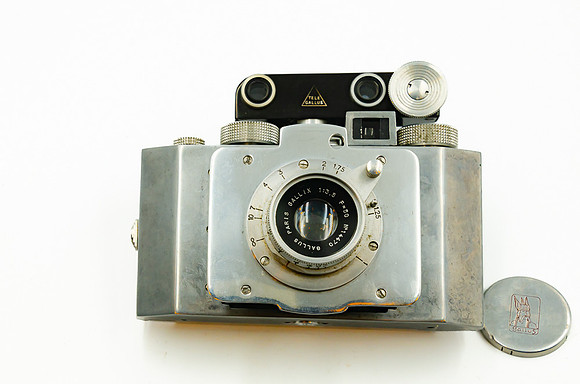
Origins and Manufacturing Context (France, 1945–1949)
After WWII, the German company C.F. Foth, known for the Foth Derby, relocated operations to Paris. The French firm Gallus took over production of the Derby‑Lux around 1945, and by 1947 renamed the model Derlux.
Key historical points:
• The Derlux appears immediately after the liberation of France, during a period of industrial scarcity and improvisation.
• Gallus produced cameras in short runs, with limited distribution outside France.
• The Derlux was part of a broader French effort to revive domestic optical manufacturing in competition with Germany and the rising Japanese industry.
⚙️ Technical Characteristics
1. Strut‑Folding Aluminium Body
• Entirely polished aluminium—no leatherette, no paint.
• Front standard pulls out on struts, with a small bellows behind the lens panel.
• The design is visually striking and mechanically unusual for a 127 camera.
2. Focal‑Plane Shutter (1/25–1/500 + B)
• Borrowed conceptually from the Foth Derby, but not identical.
• Shutter speeds selected via the large top knob, which also winds the film.
3. Lenses
Typical lenses include:
• Gallix 50mm f/3.5 (made by Gallus)
• Berthiot Flor 50mm f/2.8 (highly regarded, rare)
• Boyer Saphir 50mm f/3.5 or f/2.8
These French lenses give the Derlux a distinctive rendering and are a major factor in collector interest.
4. Film Format and Viewing Windows
• Uses 127 roll film, producing 3×4 cm images.
• Back features four windows—two red, two green—paired with a depth‑of‑field table.
• A sliding internal mask allows switching between window sets depending on film type (orthochromatic vs panchromatic).
🌍 Historical Significance
1. A Post‑War French Industrial Statement
The Derlux embodies the improvisational, resource‑limited but highly creative spirit of post‑liberation France. Its polished aluminium body and unusual mechanics reflect a period when French manufacturers were experimenting with identity and design.
2. A Rare Example of a Compact Focal‑Plane 127 Camera
Very few compact 127 cameras used a focal‑plane shutter—this was a bold engineering choice, inherited from the Derby but re‑implemented by Gallus.
3. A Bridge Between German and French Camera Traditions
The Derlux is historically important because it represents:
• German pre‑war engineering (Foth)
• French post‑war reinterpretation (Gallus)
• A hybrid lineage that is unusual in camera history
4. Increasing Collector Interest
The Derlux is considered somewhat rare, with values ranging widely depending on lens and condition. Exceptional examples with fast lenses (e.g., Berthiot Flor f/2.8) have sold for unusually high prices.
🎯 Why the Derlux Matters to a Collector Like You
Given your focus on engineering transitions, international manufacturing histories, and unusual design philosophies, the Derlux is a perfect fit:
• It is one of the most distinctive French cameras of the 1940s.
• It represents a post‑war rebirth of a German design under French craftsmanship.
• Its polished aluminium body and focal‑plane shutter make it mechanically and aesthetically unique.
• It is rare enough to be meaningful, but still accessible for collectors.