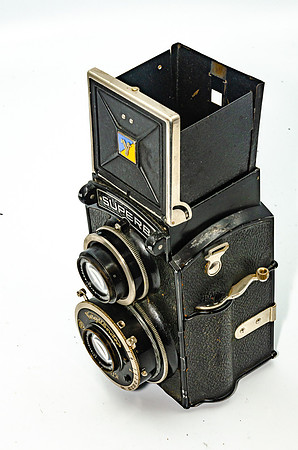
Voigtländer Superb (c.1933): History, Construction & Significance
🛠️ 1. Origins and Manufacturing Context
• Manufacturer: Voigtländer & Sohn A.G., Braunschweig
• Production period: 1933–1939/43 (sources vary slightly)
• Format: 6×6 cm on 120 roll film
• Positioning: Voigtländer’s first and only true TLR, created to compete with the Rolleiflex but with a completely different mechanical philosophy.
• Despite superficial similarity, the Superb was not a Rollei copy; Voigtländer had earlier TLR‑type designs (e.g., Stereflektoskop), predating Franke & Heidecke’s Heidoscop lineage.
🧩 2. Construction & Mechanical Innovations
A. Body & Layout
• All‑metal, highly machined body with a distinctive baroque/steampunk aesthetic.
• Horizontal film travel—unusual for TLRs—allowing a compact, rigid internal layout.
• Early models: cast‑metal “ear” strap lugs; later models: pressed‑metal lugs screwed on.
B. Viewing & Focusing System
• Waist‑level finder with folding hood and magnifier.
• Automatic tilting viewing lens linked to the focusing mechanism, providing automatic parallax correction—a major innovation not found on Rolleiflex at the time.
• Focus achieved by rotating the viewing lens; external gearing couples it to the taking lens helical.
C. Optics
• Taking lens:
• Standard: 7.5 cm f/3.5 Skopar Anastigmat
• Optional: Heliar (rare and highly prized)
• Viewing lens: 7.5 cm f/3.5 Helomar
• Both uncoated (typical for early 1930s).
D. Shutter & Controls
• Compur leaf shutter, 1–1/250 s + B & T.
• Shutter speed engravings are reversed so they can be read correctly via a small reflex prism when looking down—another unique Superb feature.
• Aperture and shutter settings visible from above without tilting the camera.
E. Film Advance
• Left‑thumb rapid‑wind lever.
• Frame counter allows advance without relying on the red window (though no auto‑stop mechanism).
• Some models include a special lever for changing film without winding.
🌍 3. Historical Significance
A. A Bold Alternative to the Rolleiflex
Voigtländer deliberately avoided copying the Rolleiflex and instead engineered a TLR with:
• Horizontal film path
• Automatic parallax correction
• Prism‑read shutter speeds
• Distinctive mechanical coupling between viewing and taking lenses
These innovations made the Superb one of the most technically advanced TLRs of the 1930s.
B. Voigtländer’s Only True TLR
Despite its engineering brilliance, the Superb did not sell as well as the Rolleiflex and remained Voigtländer’s sole serious TLR. Production ended before WWII.
C. Aesthetic & Industrial Design Importance
Collectors prize the Superb for:
• Its distinctive Art Deco / steampunk appearance
• Precision machining and brass fittings
• Unique mechanical solutions not seen in other TLRs
Its design stands apart from all contemporaries—nothing else looks like a Superb.
D. Optical Heritage
Voigtländer’s Skopar and Heliar lenses were among the finest of the era, giving the Superb excellent image quality that still impresses modern users.
🏛️ 4. Collector Importance Today
Why the Superb matters to collectors like you:
• Engineering rarity: A TLR built with Voigtländer’s precision instrument heritage.
• Short production run: Fewer units than Rolleiflex equivalents.
• Optical excellence: Skopar and especially Heliar versions are highly desirable.
• Distinctive mechanics: Automatic parallax correction and reversed‑engraving shutter readout are unique in TLR history.
• Aesthetic appeal: One of the most visually striking cameras of the 1930s.
📌 Summary
The Voigtländer Superb (1933) is a landmark in TLR design—an ambitious, mechanically inventive camera that challenged the Rolleiflex with solutions no other manufacturer attempted. Its combination of engineering ingenuity, optical quality, and distinctive styling makes it one of the most historically significant and collectible TLRs of the pre‑war era.