Butcher’s Reflex Carbine (c.1925): History, Making & Significance
⭐ Why This Camera Matters
The Butcher’s Reflex Carbine is one of the earliest compact roll‑film single‑lens reflex (SLR) cameras made in Britain. Produced roughly 1912–1925, it represents a transitional moment when British manufacturers were adapting SLR technology—previously used mainly in large plate cameras—into portable, affordable roll‑film designs for serious amateurs.
🕰️ 1. Historical Background (1912–1925)
📌 Origins
• Manufactured by W. Butcher & Sons, a major British camera maker founded in the late 19th century.
• Production period: c.1912–1925.
• This places the Reflex Carbine in the years just before the full merger of Houghton and Butcher in 1926, which later became Ensign Ltd.
📌 Purpose of the Design
The Reflex Carbine was intended to be:
• Compact compared to plate SLRs
• Affordable for advanced amateurs
• More precise than simple box or folding cameras
• Faster to use thanks to reflex focusing and roll film
It was part of Butcher’s broader Carbine line, which included folding and compact cameras.
🛠️ 2. Construction & Technical Design
🧱 Body & Materials
• Constructed primarily of wood, covered in black Morocco leatherette.
• Metal fittings and internal mechanisms were precision‑machined.
🎞️ Film Format
• Used 120 roll film, producing 2¼ × 3¼ inch negatives.
• This made it far more portable than plate‑based SLRs.
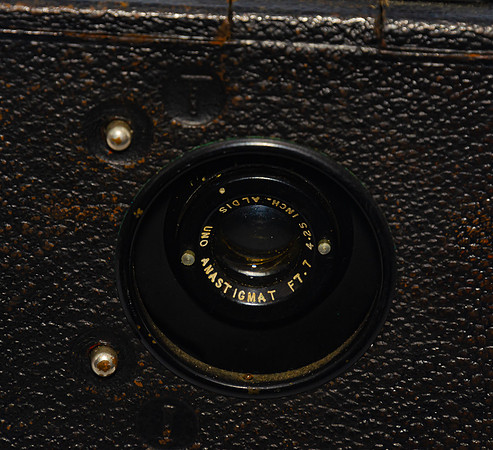
🔍 Lens & Shutter
Typical lens:
• Aldis Uno Anastigmat f/7.7 (sometimes f/4.25 versions exist).
Shutter:
• Instant + Time exposures
• Two separate shutter release buttons
• Some later examples have a single‑speed shutter (Science Museum example).
⚙️ Reflex Mechanism
• True single‑lens reflex design:
• A mirror reflects the image upward to a ground‑glass screen.
• The mirror flips up when the shutter fires.
• The user must manually reset the mirror using a lever.
• A cloth viewing hood allows waist‑level focusing.
🎚️ Focusing
• Side‑mounted focusing knob moves the lens standard.
🧭 3. How It Was Made
🏭 Manufacturing Approach
• Built in London by W. Butcher & Sons, who by this time were transitioning from importing German cameras to manufacturing their own due to WWI restrictions.
• The Reflex Carbine was assembled from:
• Hand‑finished wooden body components
• Leatherette coverings
• Brass and steel shutter/mirror mechanisms
• Aldis‑made British lenses
📦 Market Position
• Marketed as a compact reflex camera for advanced amateurs.
• Less expensive than plate SLRs from Thornton‑Pickard or Newman & Guardia.
• More sophisticated than simple box cameras or folding cameras.
🌍 4. Significance in Photographic History
🎯 1. One of the Earliest Compact Roll‑Film SLRs
Most SLRs before WWI were large plate cameras.
The Reflex Carbine brought SLR focusing precision to a hand‑sized roll‑film camera, making it a technological bridge between Victorian reflex cameras and later 20th‑century SLRs.
🎯 2. British Engineering During a Transitional Era
The camera reflects:
• Britain’s shift from German imports to domestic production (due to WWI).
• The merging of Houghton and Butcher into what would become Ensign, one of the UK’s major camera brands.
🎯 3. A Rare Example of Early SLR Miniaturisation
The Reflex Carbine shows early attempts to:
• Miniaturise reflex mechanisms
• Use roll film instead of plates
• Make SLRs accessible to non‑professionals
This foreshadows later compact SLRs of the 1930s–50s.
🎯 4. Collectability
Collectors value the Reflex Carbine because:
• It is uncommon, especially in working condition.
• It represents a unique British SLR design.
• Surviving examples often show wear due to the delicate mirror mechanism.