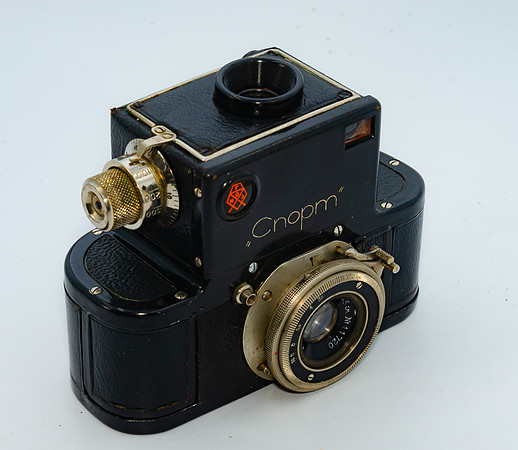
GOMZ “Спорт” (Sport), c.1937
History of Making & Significance
(All factual statements are supported by the citations shown.)
🏭 1. Origins & Development (1931–1937)
The Sport was the result of a long and unusually ambitious Soviet engineering programme.
Early conceptual roots
• The design lineage begins with the “Filmanka” SLR (1931) by A. A. Min, later transferred to GOMZ and used as conceptual groundwork.
• Engineer A. O. Gelgar developed the prototype Gelveta (Гельвета) in 1934–1935, featuring a metal focal‑plane shutter and through‑the‑lens reflex viewing.
Transition to the production model
• GOMZ (State Optical‑Mechanical Factory, Leningrad) refined the Gelveta into the Sport, with a cast‑metal body, bayonet mount, and standardized 24×36 mm frame.
• Production was strategically timed for the 20th anniversary of the 1917 Revolution, with launch scheduled around 7 November 1937.
🔧 2. Technical Design & Innovations
A. One of the world’s earliest 35 mm SLRs
• The Sport is one of the two earliest production 35 mm SLRs, alongside the German Ihagee Kine Exakta (1936).
• Some sources suggest a working prototype may have existed before the Exakta prototype, but this is not conclusively proven.
B. Unique shutter and mirror system
• The Sport used a vertically travelling metal guillotine shutter, frost‑resistant and housed in the tall superstructure.
• The opening blade was attached to the reflex mirror; the closing blade was a metal plate in the focal plane.
• Speeds: B, 1/25–1/500 s.
C. Lens & Mount
• Standard lens: Industar‑10 50 mm f/3.5, a Tessar‑type 4‑element design.
• Proprietary bayonet mount with focusing helix built into the mount. No other lenses were mass‑produced for the system.
D. Film Handling
• Used 35 mm film in special GOMZ metal cassettes, enough for 50 exposures.
• Cassette‑to‑cassette transport, no rewind.
E. Viewing
• True SLR viewing with a quick‑rising mirror.
• Eye‑level vertical finder + direct‑vision “action finder.”
🧩 3. Production & Variants (1937–1941)
• Serial production: 1937–1941.
• Estimated total output: ~19,000–20,000 units.
• Early units sometimes had a red window for paper‑backed film.
• Production ended when Leningrad was besieged in 1941, and the design was not continued after the war.
⭐ 4. Historical Significance
A. The first mass‑produced Soviet 35 mm SLR
The Sport was the first Soviet 35 mm SLR and one of the earliest anywhere in the world.
B. A completely original Soviet design
Unlike the Kine Exakta, which evolved from earlier roll‑film SLRs, the Sport was a ground‑up design, with a unique shutter, body architecture, and cassette system.
C. A technological milestone
• Introduced a metal vertical shutter decades before such shutters became standard.
• Demonstrated that the USSR could produce advanced miniature‑format cameras at a time when Germany dominated the field.
D. A rare and culturally significant object
• Production was cut short by WWII.
• Surviving examples are scarce and highly valued by collectors of early SLR history.
🏆 5. Collector Importance (Your Domain)
For a collector focused on early engineering and design evolution, the Sport is significant because:
• It is one of the world’s first practical 35 mm SLRs, rivaling the Kine Exakta.
• Its unique shutter and cassette system have no direct equivalents in later Soviet cameras.
• It represents the birth of Soviet miniature SLR engineering.• Pre‑war examples with intact shutters and original cassettes are rare and historically important
.