Historical Context (1955–1958)
Argus in the 1950s
Argus, based in Ann Arbor, Michigan, was one of the largest American camera manufacturers after WWII.
Its success came from:
• the Argus A (1936),
• the Argus C3 (1939–1966), one of the best‑selling cameras in history.
But by the mid‑1950s:
• German cameras (Leica, Contax, Voigtländer) dominated the high end,
• Japanese cameras (Canon, Nikon, Minolta) were rapidly improving,
• American manufacturers struggled to innovate.
Argus needed a modern, high‑quality system camera to compete.
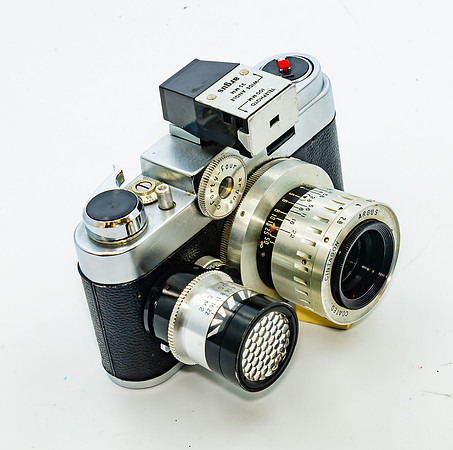
The result was the Argus C44, introduced in 1956.
2. Design and Construction
A major step up from the C3
The C44 was not an evolution of the C3 — it was a complete redesign, aimed at the advanced amateur.
Key features
• Interchangeable lenses (a first for Argus)
• Coupled rangefinder
• Brightline viewfinder
• Rapid film advance lever
• Shutter speeds: 1/10–1/300 + B
• Lens mount: proprietary Argus bayonet
• Standard lens: Cintar 50mm f/2.8 (made by Bausch & Lomb or Argus)
• Optional lenses:
• 35mm f/4.5
• 100mm f/4.5
• 135mm f/4.5
Build quality
The C44 was:
• heavier and more solid than the C3,
• finished in brushed aluminum and leatherette,
• mechanically more refined,
• ergonomically more modern.
It was the closest Argus ever came to producing a true system camera.
3. Why the Argus C44 Was Important
1. The most advanced Argus ever made
The C44 represented:
• the company’s peak engineering capability,
• its only serious attempt at a modular camera system,
• a major leap beyond the simple, boxy C3.
2. A rare example of American camera innovation
By the mid‑1950s, the U.S. camera industry was declining.
The C44 stands out as one of the few American cameras that:
• offered interchangeable lenses,
• had a coupled rangefinder,
• was built to compete with European designs.
3. A transitional camera caught in a shifting market
The C44 was introduced at the worst possible moment:
• Japanese cameras were rapidly improving,
• German cameras still dominated prestige,
• American consumers were shifting toward SLRs.
The C44 was technically good — but the market had moved on.
4. A symbol of Argus’s final years
The C44 was intended to save the company.
Instead, it became:
• too expensive to produce,
• too complex for Argus’s traditional customer base,
• overshadowed by imported cameras.
Argus ceased major camera production in the early 1960s.
4. Collector Significance
Why collectors value the C44
• Distinctive American engineering
• Short production run
• Complete lens system available
• Attractive mid‑century industrial design
• A “what if” moment in U.S. camera history
Rarity
The C44 is not extremely rare, but:
• complete kits with multiple lenses,
• original cases,
• working shutters and rangefinders
are increasingly hard to find.
Design appeal
The C44 has a strong mid‑century aesthetic:
• brushed metal,
• clean lines,
• bold typography,
• a modern, purposeful look.
It displays beautifully.
5. Significance in Photographic History
Technically
The C44 showed that Argus could build:
• a sophisticated rangefinder,
• a modular lens system,
• a modern camera body.
It was a genuine attempt to compete with the best.
Historically
The C44 marks:
• the end of American dominance in consumer cameras,
• the rise of Japanese optical engineering,
• the final chapter of Argus as a major manufacturer.
Culturally
The C44 is a symbol of:
• American mid‑century optimism,
• industrial design experimentation,
• the transitional era between simple box cameras and advanced SLRs.
Summary
The Argus C44 (c.1956) is:
• the most advanced camera Argus ever produced,
• a bold but ultimately unsuccessful attempt to enter the high‑end market,
• a fascinating artifact of American photographic history,
• a collectible mid‑century design object.
It represents both the peak and the decline of Argus — a company that helped democratize photography in the United States.