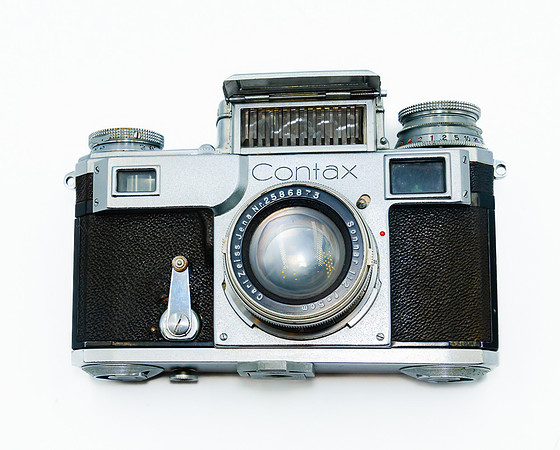
Contax (c.1932): The Ambitious Zeiss Ikon Rangefinder That Challenged Leica
The 1932 Contax—now known as the Contax I—was Zeiss Ikon’s first 35 mm interchangeable‑lens rangefinder and one of the most technologically daring cameras of the early 20th century. It was designed explicitly to outperform the Leica II, and although brilliant in concept, it was mechanically fragile and short‑lived.
Below is a clear, historically grounded account of its creation, engineering, and significance.
🏭 1. How the 1932 Contax Was Made
A Zeiss Ikon “moonshot” project
• After Leica’s unexpected commercial success, Zeiss Ikon—then the world’s largest photographic conglomerate—decided to build a superior 35 mm system camera.
• The name Contax was chosen after an internal poll.
• Chief designer: Dr. Heinz Küppenbender, who envisioned a camera that was faster, more precise, and more modular than any Leica.
Manufacturing period
• Produced 1932–1936, with continuous internal revisions (at least six major mechanical updates).
• Built in Dresden, Germany, using die‑cast alloy bodies and precision‑machined components.
Engineering innovations
The Contax I introduced several radical design choices:
1. Vertically‑traveling metal focal‑plane shutter
• Made of interlocking blackened brass slats, like a miniature roll‑up door.
• Allowed 1/1000 s top speed—double the Leica II’s 1/500 s.
• Burn‑proof compared to Leica’s cloth curtains.
• Aligned by woven silk ribbons, strong but prone to wear.
2. Long‑base coupled rangefinder
• Much longer baseline than Leica → greater focusing accuracy, especially with fast lenses.
• Used a rotating wedge mechanism rather than Leica’s swinging mirror.
3. Bayonet lens mount
• Faster lens changes than Leica’s screw mount.
• Internal bayonet for standard lenses; external bayonet for tele/wide lenses.
• This dual‑bayonet system later influenced Nikon’s early rangefinders.
4. Removable back
• Allowed easier film loading than Leica’s bottom‑loading system.
🔧 2. Technical Specifications (Typical 1932 Configuration)
• Lens: 5 cm f/3.5 or f/2.8 Zeiss Tessar (uncoated)
• Shutter: 1/25–1/1000 s + B
• Body: Black enamel over die‑cast alloy
• Format: 24×36 mm on 35 mm cine film
• Focusing: Helical to ~0.9 m
🌍 3. Historical Significance
⭐ 1. Zeiss Ikon’s first true system camera
The Contax I launched the Contax system, with interchangeable lenses, close‑up attachments, finders, and accessories—what Zeiss called the Universalkamera.
⭐ 2. A direct challenger to Leica
Zeiss intended the Contax to be technically superior in every measurable way:
• faster shutter
• more accurate rangefinder
• quicker lens changes
• more robust shutter material
In many respects, they succeeded—on paper.
⭐ 3. A brilliant but flawed design
The Contax I’s shutter was notoriously unreliable, and most surviving examples today have inoperative shutters.
Its mechanical complexity made repairs extremely difficult.
This is why the Contax I was replaced by the Contax II (1936), one of the most important rangefinders ever made.
⭐ 4. A milestone in shutter evolution
Despite its flaws, the Contax I introduced the vertically traveling metal shutter, a concept that influenced later professional cameras.
⭐ 5. A cornerstone of pre‑war German camera engineering
The Contax I represents the peak of Dresden’s pre‑war innovation—ambitious, precision‑driven, and uncompromising.
🧭 4. Why the 1932 Contax Matters Today
Historically
• It is the first Contax, the origin of a legendary camera line.
• It marks the moment Zeiss Ikon entered the 35 mm race.
• It pushed camera engineering into new territory.
Collecting
• Rare, especially early “pimple” variants.
• Highly desirable as a display piece.
• Often non‑functional due to shutter issues—collectors value originality over usability.
Technically
• Introduced concepts that shaped later rangefinders and even SLR shutters.
• Its long‑base rangefinder remains one of the most accurate of the era