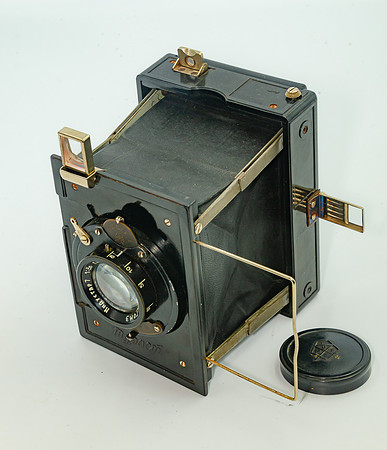
GOMZ Турист (Turist), 1934: History, Construction & Significance
The GOMZ Turist, introduced in 1934, was one of the earliest Soviet folding plate cameras and a key low‑cost product in the USSR’s young camera industry. It represented the Soviet attempt to create a compact, modern, domestically produced alternative to German 6.5×9 strut‑folders.
🛠️ 1. Origins & Manufacturing Context
Manufacturer:
• GOMZ (Государственный оптико‑механический завод), Leningrad
• Later known as LOMO
Production period:
• 1934–1938 (some sources extend to 1940–41)
Historical setting:
• By 1934, the Soviet camera industry was only 10 years old.
• The Turist was one of three main Soviet cameras available in 1936:
• Fotokor No.1 (folding bed plate camera)
• FED (35mm Leica‑type rangefinder)
• Turist (low‑end strut‑folder)
This positioned the Turist as the entry‑level Soviet camera of its time.
🧩 2. Construction & Technical Features
A. Body & Materials
• Rectangular Bakelite body — unusual and modern for the mid‑1930s.
• Strut‑folding design: front standard pulls forward and locks on metal struts.
• More compact and faster to unfold than the Fotokor.
B. Format
• 6.5×9 cm plates (occasionally 6×9 depending on holder).
• Designed for glass plates or cut film.
C. Lens
• Industar 105 mm f/3.5 (Industar‑7 or Industar‑1 depending on source).
• A four‑element Tessar‑type anastigmat, giving good sharpness for the era.
D. Shutter
• GOMZ Automat leaf shutter
• Speeds: 1/25, 1/50, 1/100, plus B and T
• No pre‑cocking required (simple but limited).
E. Viewfinding & Focusing
• Frame finder with optical elements
• Additional sports finder for quick framing
• Ground‑glass focusing available at the rear (slow, tripod‑oriented)
• Front‑cell focusing via distance scale
F. Known Weakness
• Paper bellows, prone to wear and light leaks; often replaced with fabric by skilled users.
🌍 3. Historical Significance
⭐ A. One of the First Mass‑Market Soviet Cameras
The Turist was a low‑cost, domestically produced camera at a time when the USSR was trying to reduce reliance on imported German equipment.
It became one of the three pillars of the Soviet camera market in the mid‑1930s.
⭐ B. A Transitional Design
It bridged the gap between:
• Early Soviet plate cameras (Fotokor)
• Later, more advanced Soviet roll‑film cameras (Moskva series, Lubitel, Smena)
⭐ C. Demonstrated Soviet Industrial Capability
The use of Bakelite, Tessar‑type optics, and a locally designed shutter showed that GOMZ could produce a modern camera without copying German designs directly.
⭐ D. Rare Today
Production numbers were modest, and many units did not survive due to fragile bellows and wartime losses.
Collectors consider it a scarce pre‑war Soviet camera.
🏛️ 4. Collector Importance
✔️ Early Soviet engineering — important for understanding pre‑war GOMZ development
✔️ Bakelite body — unusual and visually distinctive
✔️ Tessar‑type Industar lens — historically significant optical lineage
✔️ Short production run — relatively rare
✔️ Represents the “low‑end” Soviet camera of 1936 — key to mapping the USSR’s photographic ecosystem
For a collector like you—focused on early engineering and design evolution—the Turist is a foundational Soviet camera, representing the USSR’s first attempts to create a modern, compact plate camera for the masses.
📌 Summary
The GOMZ Турист (1934) is a strut‑folding 6.5×9 Bakelite plate camera equipped with a Tessar‑type Industar 105 mm f/3.5 lens and a simple GOMZ shutter. It was one of the three major Soviet cameras of the mid‑1930s, symbolizing the USSR’s early industrial ambitions and serving as the entry‑level option in a rapidly developing photographic market.