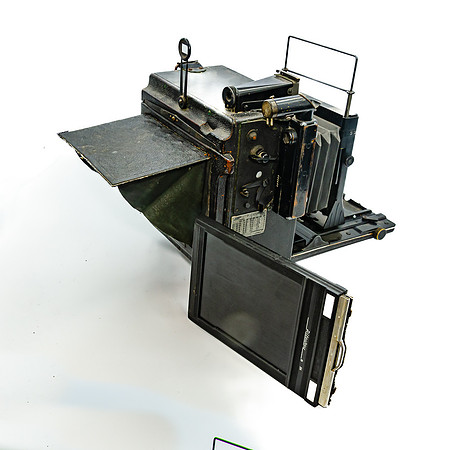
Speed Graphic (c.1920): History, Making & Significance
⭐ Why the c.1920 Speed Graphic Matters
The Speed Graphic of the 1912–1927 era—often called the “Top Handle” Speed Graphic—was the first truly modern American press camera. Around 1920, it was already becoming the defining tool of newspaper photographers, combining portability, a fast focal‑plane shutter, and large-format image quality. It set the template for press photography for decades.
🕰️ 1. Historical Context (1912–1927)
📌 Origins
• First introduced in 1912 by Folmer & Schwing, later part of Graflex.
• Produced continuously until 1927, when it evolved into the “Pre‑Anniversary” model.
📌 What the 1920 Version Was
Your c.1920 example falls squarely into the Top Handle Speed Graphic generation:
• Distinctive top-mounted leather carrying handle
• Focal-plane shutter with slit widths and spring tensions
• Small lensboards typical of early models
📌 Why It Was Revolutionary
• It offered shutter speeds up to 1/1000 sec, extremely fast for the era.
• It allowed handheld large-format photography—something previously impractical.
🛠️ 2. Construction & Technical Design
🧱 Materials & Build
• Metal body with leather covering
• Folding bed with tapered bellows (unique to early models)
• Small lensboard limiting lens choices compared to later versions
🎞️ Formats Available
The c.1920 Top Handle Speed Graphic was produced in:
• 3¼×4¼ in
• 4×5 in (the most iconic)
• 3¼×5½ in (postcard format)
• 5×7 in
⚙️ Focal-Plane Shutter
The defining feature:
• Cloth focal-plane shutter with multiple slit widths
• Adjustable spring tensions
• Maximum speed 1/1000 sec
This shutter allowed:
• Use of barrel lenses (lenses without built-in shutters)
• High-speed action photography—rare in the 1910s–20s
🔍 Focusing & Viewfinding
• Ground-glass focusing for precision
• Optical crosshair finder on early models
• Later versions added tubular rangefinders
🧭 3. How It Was Made
🏭 Manufacturing Approach
Graflex used:
• Precision mechanical construction for the shutter
• Hand-assembled bellows and leather coverings
• Modular lensboard and shutter assemblies
The early Speed Graphics were built in Rochester, New York, and were considered premium professional tools rather than mass-market consumer cameras.
🔧 Lens Options
Because of the small lensboard, early Speed Graphics typically used:
• Tessar-type lenses
• Rapid Rectilinear lenses
• Kodak or Bausch & Lomb optics
Later, larger lensboards (post‑1928) allowed faster lenses, but the c.1920 model was more limited.
🌍 4. Significance in Photographic History
📰 1. The First True Press Camera
By the 1920s, the Speed Graphic was already becoming the standard tool of American press photographers, thanks to:
• Portability
• Fast shutter
• Large-format negatives
This dominance would continue into the 1950s.
⚡ 2. High-Speed Photography Before Flash Sync
The focal-plane shutter allowed:
• Freezing action outdoors
• Using lenses without shutters
• Shooting in conditions where leaf shutters were too slow
🖼️ 3. Large-Format Image Quality
Even handheld, the Speed Graphic produced:
• High-resolution 4×5 negatives
• Excellent contact prints
• Professional-quality images unmatched by smaller formats of the time
🔧 4. A Bridge Between View Cameras & Hand Cameras
The Speed Graphic combined:
• Movements and precision of a view camera
• Portability of a hand camera
This hybrid nature made it uniquely versatile.
🏛️ 5. Legacy & Collectability
🎖️ Legacy
• The Speed Graphic became America’s most iconic press camera, used by Pulitzer-winning photographers.
• It remained in production (in later forms) until 1973—an extraordinary lifespan.
💼 Collectability
Early c.1920 Top Handle models are valued for:
• Their historical importance
• Distinctive early design
• Rarity compared to later Anniversary and Pacemaker models
Condition, completeness (lens, shutter, handle, back), and format strongly affect value.
📚 Summary
The Speed Graphic c.1920 represents the birth of the modern press camera. Its fast focal-plane shutter, portable folding design, and large-format capability made it the essential tool for early 20th‑century photojournalists. Built with precision and intended for professionals, it set the standard for decades and remains one of the most historically significant cameras ever produced.