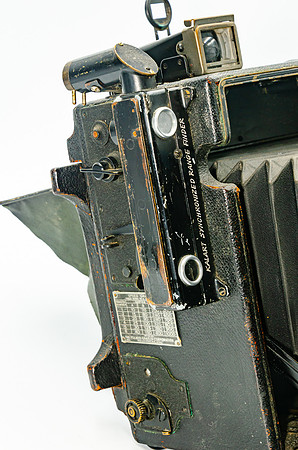
Kalart Rangefinder: History, Origins & Significance
⭐ Summary
The Kalart rangefinder, invented by Morris A. Schwartz in 1936, became the dominant focusing system on American press cameras—especially the Graflex Speed Graphic—from the late 1930s through the 1950s. It provided automatic coupled focusing, worked with almost any lens, and introduced the famous Focuspot accessory for low‑light focusing.
🕰️ 1. Origins of Kalart & Its Founder
👤 Morris A. Schwartz
• Born in Russia, emigrated to the U.S. in 1906.
• Worked as a photographer for the New York Times and Jewish Daily Forward.
• Founded Kalart in 1930 (Brooklyn, NY) as an industrial photography lab.
• A prolific inventor with 100+ photographic patents.
• Invented the first photoflash synchronizer (1930) and later the Kalart rangefinder (1936).
🏭 The Company
• Kalart Company, Inc. (1930–1957)
• Later Kalart‑Victor Corporation (1957–1989)
• Based in Brooklyn → Stamford → Plainville, Connecticut.
🔧 2. Invention of the Kalart Rangefinder (1936)
📌 What It Was
The Kalart Synchronized Range Finder was an accessory, side‑mounted, coupled rangefinder that automatically adjusted focus by linking to the camera’s focusing rails.
It was not built into the camera body—Graflex, Busch, and others purchased it from Kalart.
📌 Why It Mattered
Before Kalart:
• Press photographers relied on ground glass, scale focusing, or uncoupled optical rangefinders.
• Focusing was slow and difficult in fast‑moving news situations.
Kalart changed everything:
• Allowed fast, accurate, handheld focusing on large‑format cameras.
• Became the standard on Speed Graphics and other press cameras.
💡 3. The Focuspot (1936)
One of Schwartz’s cleverest inventions was the Focuspot, introduced alongside the rangefinder.
• It projected two beams of light from the rangefinder windows.
• When the beams overlapped on the subject, the camera was in focus.
• Enabled night‑time focusing long before electronic aids existed.
This was revolutionary for indoor sports, crime scenes, and night press work.
🧭 4. Adoption on Press Cameras (Late 1930s–1950s)
📸 Graflex Speed Graphic
The Kalart rangefinder became almost synonymous with the Speed Graphic:
• Many photographers assumed “Kalart” was the camera brand.
• It was the most common focusing system on American press cameras of the mid‑20th century.
🏆 Why Press Photographers Loved It
• Reliable mechanical linkage
• Adjustable for different lenses
• Worked in low light with the Focuspot
• Allowed rapid handheld shooting with 4×5 film
This made it a cornerstone of American photojournalism.
🛠️ 5. Technical Evolution
🧩 Early Models
• Metallic finish
• External adjustment scales
• Different actuating arm design
• Required more complex calibration
🧩 Later Models
• Cleaner housing
• Internalized adjustments
• Improved coupling mechanisms
• Widely standardized across press cameras
🗂️ 6. Timeline of Key Events
🏛️ 7. Significance in Photographic History
📌 1. Standardization of Press Photography
Kalart made fast, accurate focusing possible on large‑format cameras—critical for news, sports, and crime photography.
📌 2. Democratization of Precision Focusing
It allowed any photographer to achieve Leica‑like focusing accuracy on a 4×5 camera.
📌 3. Mechanical Excellence
The system was:
• Durable
• Adjustable
• Compatible with many lenses
• Easy to service
📌 4. Cultural Impact
The Kalart‑equipped Speed Graphic became the iconic American press camera, immortalized in films, newsreels, and Pulitzer‑winning photographs.