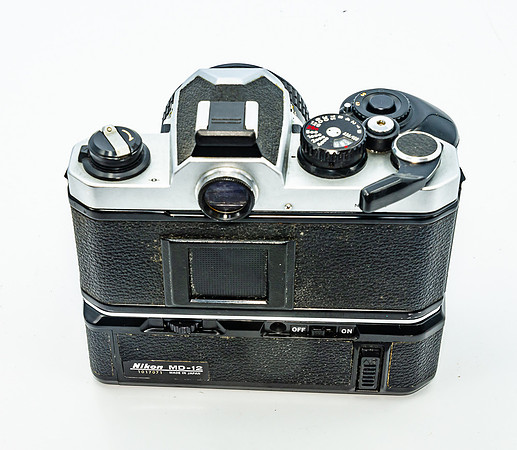
Origins and Manufacturing Context
Nikon in the early 1980s
By 1982, Nikon was navigating a rapidly changing market:
• Electronics were taking over SLR design.
• Canon, Minolta, and Pentax were pushing automation.
• Nikon’s professional flagship was the F3 (1980), an electronic camera.
But many photographers—especially photojournalists, scientists, and extreme‑environment shooters—still demanded:
• full mechanical reliability,
• battery‑independent operation,
• rugged construction,
• compatibility with decades of F‑mount lenses.
The FM2 was Nikon’s answer: a compact, fully mechanical, high‑precision SLR that could survive conditions where electronic cameras failed.
🔧 2. Technical Design and Construction
A breakthrough shutter
The FM2 introduced a vertical‑travel metal shutter with a top speed of 1/4000 s—the fastest mechanical shutter ever put into mass production at the time.
Key innovations:
• Early models used titanium honeycomb-pattern blades.
• Later models (late 1980s onward) used aluminum blades thanks to improved manufacturing.
Flash sync
• Original FM2: 1/200 s
• FM2n (1984): 1/250 s
This was exceptionally fast for a mechanical camera.
Build quality
• Body made of copper‑aluminum‑silicon alloy (silumin).
• Film transport built on hardened metal gears and ball bearings.
• Mirror mechanism derived from the professional Nikon F2.
Metering
• 60/40 center‑weighted TTL meter.
• Battery powers only the meter; the shutter is fully mechanical.
Lens compatibility
• Full compatibility with AI and AI‑S Nikkor lenses.
• Works with most F‑mount lenses from 1977 onward.
🌍 3. Significance in Photographic History
A. The gold standard for mechanical SLRs
The FM2 became legendary because it proved that:
• mechanical cameras could still innovate,
• extreme reliability mattered,
• photographers valued tactile precision.
Its shutter speed of 1/4000 s was unprecedented and influenced later Nikon designs.
B. A camera for extreme environments
The FM2 is known for functioning in temperatures from –40°C to +50°C.
It was famously used by:
• Arctic researchers,
• mountaineers,
• military units,
• photojournalists in conflict zones.
Even today, the Canadian government reportedly uses FM2 bodies in the Arctic.
C. A long production life (1982–2001)
Few cameras—especially mechanical ones—stay in production for two decades.
The FM2 survived because:
• autofocus screens didn’t work well with manual lenses,
• many photographers still preferred manual focus,
• Nikon’s F‑mount ecosystem remained strong.
D. A bridge between eras
The FM2 sits at a pivotal moment:
• after the fully mechanical FM (1977),
• before the hybrid FM3A (2001),
• during the rise of autofocus (1985 onward).
It represents the last great purely mechanical Nikon SLR before electronics became unavoidable.
🎞️ 4. Collectability and Legacy
Why collectors value the FM2:
• Unmatched mechanical reliability.
• Iconic shutter performance.
• Compatibility with legendary Nikkor lenses.
• Long production run with multiple variants.
• A camera that “just works” decades later.
Variants
• FM2 (1982–1983) — titanium shutter, 1/200 sync.
• FM2n (1984–2001) — improved shutter, 1/250 sync.
• FM2/T (1993) — titanium top and bottom plates.
Market notes
• FM2 bodies remain highly usable and desirable.
• Titanium‑shutter early models are especially collectible.
• FM2/T is the rarest and commands premium prices.
🧭 5. Why this camera matters in your collecting framework
Given your passion for engineering transitions, historically significant designs, and mechanical excellence, the FM2 is a perfect fit because it represents:
• the pinnacle of mechanical shutter engineering,
• Nikon’s commitment to durability during the electronic revolution,
• a camera that shaped professional expectations for decades,
• a design that remains relevant and admired even today.
It’s one of those cameras that defines an era—and still feels alive in the hand