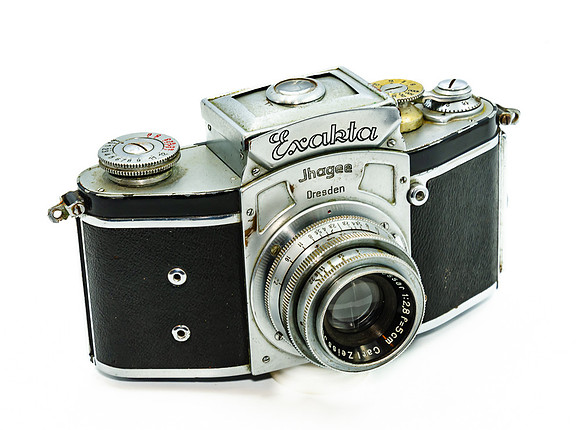
1. Why the Kine Exakta Matters
The Kine Exakta, introduced in 1936 by Ihagee Kamerawerk Dresden, was the first 35 mm SLR camera to enter regular production and the model that established the architecture of all later 35 mm SLRs. It combined interchangeable lenses, a focal‑plane shutter, reflex viewing, and 35 mm film into a coherent, usable system—something no camera had achieved before.
It is one of the most important cameras in photographic history, on the same level of influence as the Leica I (1925) and Contax I (1932).
🏭 2. Origins & Development (Dresden, 1936)
• Designed by Karl Nüchterlein, who had earlier created the VP Exakta (1933), a 127‑film SLR.
• The success of Leica and Contax in the early 1930s pushed Ihagee to create a miniature‑format SLR using 35 mm cinema film.
• The camera debuted at the Leipzig Spring Fair in March 1936, marking the official birth of the 35 mm SLR.
• The name Kine (from cine) appeared only in manuals and advertising, not on the camera body.
🔧 3. Technical Innovations
The Kine Exakta introduced or standardized several features that became universal in later SLRs.
A. True Reflex Viewing
• A 45° mirror directed the image to a focusing screen under a folding hood.
• Ihagee replaced the traditional ground glass with a plano‑convex magnifying screen to make focusing feasible at 35 mm scale.
• A swing‑in magnifier allowed critical focusing.
B. Interchangeable Lenses (Exakta Bayonet)
• Introduced the Exakta bayonet, a robust mount that supported a full lens ecosystem from Zeiss, Schneider, and Meyer.
• Supported macro, micro, and scientific attachments—one reason the Exakta became beloved by laboratories.
C. Focal‑Plane Shutter
• Horizontal cloth shutter with speeds from 12 s to 1/1000 s—exceptional for 1936.
• Included a built‑in self‑timer and long‑exposure timing mechanism.
D. 35 mm Film Handling
• Used standard perforated 35 mm film in reusable metal cassettes.
• A unique built‑in film cutter allowed removing a partially exposed roll for early development—an ingenious feature rarely seen even today.
E. Integrated Film Advance + Shutter Cocking
• A single lever stroke advanced the film and cocked the shutter, preventing double exposures.
🧩 4. Variants (1936–1940)
Early Kine Exakta versions include:
• v1.1 (1936) – “Magic eye” round magnifier
• v1.2 (1936–38) – Rectangular magnifier
• v1.3 – “Exacta” name variant
• v1.4 (1938–40) – Third socket, 1/10 s shutter speed added
These early variants are highly collectible and show the rapid refinement of the system.
🧭 5. Historical Significance
A. First Practical 35 mm SLR
The Kine Exakta solved the focusing and viewing challenges that had prevented earlier miniature SLRs from being usable. Its focusing screen innovation and fast lenses (Tessar 2.8/5 cm, Biotar 2/5 cm) made 35 mm SLR photography viable.
B. Foundation of the Exakta System
The camera launched a system that would dominate scientific, medical, and macro photography for decades.
Accessories included:
• Microscope adapters
• Bellows
• Extension tubes
• Interchangeable finders (later Varex models)
C. A Dresden Engineering Triumph
The Kine Exakta is a hallmark of the Dresden camera industry—then the world’s most innovative optical‑mechanical center.
D. Influence on All Later SLRs
Its architecture—mirror box, focal‑plane shutter, interchangeable lenses, reflex viewing—became the template for:
• Praktica
• Pentax
• Nikon F
• Canonflex
• Minolta SR
• Every 35 mm SLR thereafter
🏆 6. Collector Importance (Your Domain)
For a collector focused on early engineering and design evolution, the Kine Exakta is essential because:
• It is the first production 35 mm SLR—a cornerstone of camera history.
• Early variants (1936–38) are scarce and mechanically complex.
• The camera represents the transition from plate/roll‑film SLRs to miniature precision instruments.
• Its system accessories and lens ecosystem make it one of the richest pre‑war platforms.
Given your interest in the VP Exakta → Kine Exakta evolution, this model is the pivotal link: the moment the SLR concept became modern