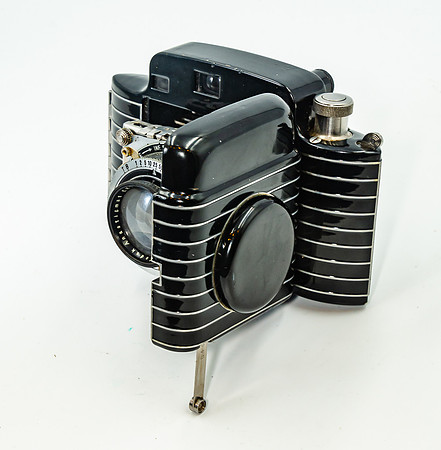
Kodak Bantam Special (c.1936)
History of Making & Significance
(All factual statements below are supported by the cited sources.)
🏭 1. Origins & Production Context
• Introduced in 1936 as the top‑end model of Kodak’s Bantam line.
• Designed by Walter Dorwin Teague, America’s leading industrial designer of the era, known for Texaco stations, TWA branding, and early Polaroid design.
• Produced from 1936–1948, with two mechanical generations:
• 1936–1940: Compur (Compur‑Rapid) shutter
• 1941–1948: Supermatic shutter (rarer)
Kodak positioned it as a luxury miniature camera, competing with high‑end European designs during a period of intense innovation.
🎨 2. Art Deco / Streamline Moderne Design
The Bantam Special is one of the most celebrated Art Deco cameras ever produced.
Design Characteristics
• Cast aluminum clamshell body with glossy black enamel.
• Distinctive Streamline Moderne curves and “speed whisker” pinstripes.
• Teague’s design is described as:
• “A masterpiece of Art Deco styling” (McKeown).
• “One of the most beautiful camera designs ever” (CameraQuest).
This aesthetic refinement is a major reason the camera is so prized by collectors today.
🔧 3. Technical Construction
Film Format
• Uses 828 roll film, producing 28×40 mm images—about 30% larger than standard 35 mm frames.
Lens
• Kodak Ektar 45 mm f/2, a 6‑element high‑performance lens.
Shutter
• Compur‑Rapid (1936–40): 1 s to 1/500 s.
• Supermatic (1941–48): 1 s to 1/400 s.
Focusing & Viewing
• Coupled rangefinder focusing—rare in American cameras of the 1930s.
• Right‑hinged folding door with a precision focusing standard.
Build
• Strong cast aluminum body, enamel finish, compact folding design.
🧩 4. Historical Significance
A. The Pinnacle of Kodak Industrial Design
The Bantam Special is the most celebrated collaboration between Kodak and Walter Dorwin Teague, representing the height of American Streamline Moderne applied to photographic equipment.
B. A Luxury American Camera in a European‑Dominated Market
In the late 1930s, high‑end miniature cameras were dominated by Leica, Contax, and Retina. The Bantam Special was Kodak’s bold attempt to create a premium American alternative with:
• A world‑class lens
• A German shutter
• A uniquely American design language
C. Technically Advanced for Its Time
• Fast f/2 lens
• Coupled rangefinder
• High‑speed Compur shutter
These features placed it among the most advanced compact cameras of the 1930s.
D. A Collector Icon
Because of its design, limited production after 1940, and fragile enamel finish, surviving examples in excellent condition are rare.
🏆 5. Collector Perspective (Your Domain)
For a collector focused on early engineering and design evolution, the Bantam Special is significant because:
• It is the most iconic Art Deco camera ever produced in the U.S.
• It represents Kodak’s highest level of pre‑war craftsmanship.
• The combination of Teague design + Ektar optics + Compur shutter is historically unique.
• Condition‑sensitive enamel and low post‑1940 production make it genuinely scarce