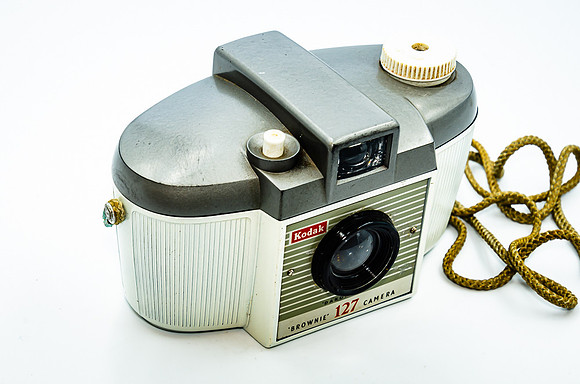
Kodak Brownie 127 “White” (c.1959): History, Making & Significance
1. Origins and Manufacturing Context
The standard Kodak Brownie 127 was introduced in 1952 and became one of the most successful British‑made Kodak cameras ever, with millions produced by 1954. It was designed as a simple, inexpensive snapshot camera for the booming post‑war amateur market.
The White Brownie 127, however, was a special, extremely limited variant produced around 1959 at Kodak’s UK factory. It was not part of the main production line.
Why it was made
• Kodak experimented with a white Bakelite body paired with a silver top plate.
• The camera was released only in the Channel Islands (Jersey) as a test market.
Why production stopped
The white plastic soiled very easily, becoming visibly dirty with normal handling.
• Kodak quickly abandoned the idea.
• Only a small batch was ever produced.
This short production window is the reason the White Brownie 127 is now one of the rarest Kodak cameras.
2. Technical Characteristics
The White Brownie 127 is mechanically identical to the standard Model 1 (1952–1959) Brownie 127.
Film & Format
• 127 roll film
• Image size: 4×6 cm
Lens
• Meniscus lens, approx. 65 mm, fixed focus
• Aperture: fixed at f/14
Shutter
• Single speed, approx. 1/50 s
• No “B” setting
Body
• Molded Bakelite
• Horizontal stepped design on the sides
• Optical direct‑vision finder
What makes the White version different
• White Bakelite body
• Silver top plate
• Produced only in Jersey
• Extremely limited numbers
3. Historical Significance
A. One of Kodak’s rarest post‑war consumer cameras
The White Brownie 127 is often called the “Albino Brownie” by collectors.
• It is one of the least common Kodak variants ever released.
• Its rarity is due to the failed experiment with light‑colored Bakelite.
B. A snapshot of 1950s design experimentation
The late 1950s saw Kodak exploring:
• New plastics
• New colors
• More modern styling
The White Brownie 127 represents this design transition, even though the experiment was short‑lived.
C. A cultural icon of British amateur photography
The Brownie 127 series was:
• Hugely popular
• Affordable
• Simple to use
• A “first camera” for millions
The White variant is a rare mutation of a mass‑market icon — a perfect example of how industrial design experiments sometimes survive only in tiny numbers.
D. A cautionary tale in materials engineering
The failure of the white body due to visible dirt accumulation shows how:
• Material color
• Surface texture
• Consumer expectations
…can make or break a product variant.
4. Collector Significance Today
Why collectors prize it
• Extremely rare (far rarer than any standard Brownie 127)
• Only sold in one small geographic region
• Often faked by repainting black models — authenticity matters
Typical value
• Good condition with case: ~£150 / $205
• Mint examples can command significantly more.
Authentication notes
Because fakes exist:
• Check for factory‑molded white Bakelite, not paint.
• Look for correct silver top plate.
• Examine internal parts for consistent coloration.
Summary
The Kodak Brownie 127 White (c.1959) is a rare, short‑run experimental variant of one of Kodak’s most popular cameras. Its significance lies in its:
• Scarcity
• Design experimentation
• Unique distribution
• Place in the evolution of post‑war British Kodak manufacturing
It is one of the most collectible Brownie cameras ever made.