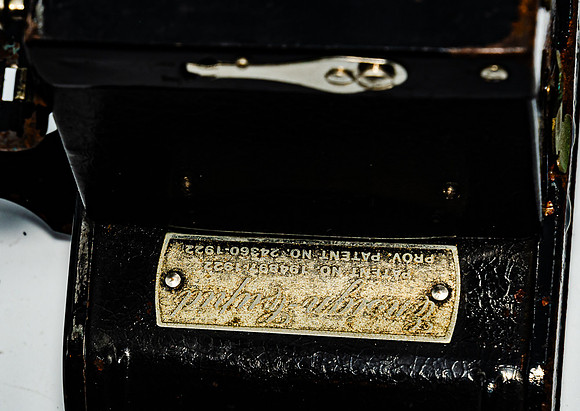
Ensign Cupid (c.1922): History, Making & Significance
⭐ Why This Camera Matters
The Ensign Cupid, introduced around 1922 by Houghton‑Butcher (London), is historically important as the first camera to use dual red windows to double the number of exposures on standard roll film. Its compact T‑shaped metal body, guillotine shutter, and clever film‑economy system made it one of the most distinctive cameras of the early Art Deco era.
🕰️ 1. Historical Background (1922–1928)
📌 Origins
• Produced by Houghton‑Butcher, a major British camera manufacturer.
• Introduced c.1922 and produced until c.1928.
• Designed during the transitional period when Houghton and Butcher were merging into Houghton‑Butcher Ltd, later Ensign Ltd.
📌 Design Roots
• Based partly on a 1914 British patent (W.H. Harvey) describing the use of two red windows to double exposures.
• Further refined by 1921 patents from V.W. Edwards and A.J. Dennis of Houghton‑Butcher.
🛠️ 2. Construction & Technical Design
🧱 Body & Materials
• All‑metal sheet‑steel body—unusual for the time.
• Distinctive T‑shaped profile (a patented design).
• Finishes:
• Crackle black (most common)
• Smooth black (early)
• Dark blue (rarer)
🎞️ Film & Format
• Uses 120 roll film.
• Produces 2¼ × 1½ inch images.
• Thanks to the dual‑window system, it yields 12–16 exposures per roll (depending on version).
🔍 Lens & Shutter
• 70 mm meniscus lens, fixed focus (approx. f/14 working aperture).
• Guillotine shutter with vertically sliding plates.
• Shutter settings: T and I (approx. 1/30 sec).
• Shutter cocked by lifting a front button; released by a second button.
📐 Viewfinding
• Simple folding frame finder.
• Optional clip‑on brilliant finder sold as an accessory.
🧭 3. How It Was Made
🏭 Manufacturing Approach
• Built in London by Houghton‑Butcher using stamped metal parts for low‑cost, high‑volume production.
• The patented T‑shaped body minimized wasted internal space, making it more compact than typical box cameras.
🔧 Patents & Innovation
Key patents associated with the Cupid include:
• 13246 (1914) – dual red window exposure‑doubling system.
• 194897 (1922) – T‑shaped rigid body design.
• 24360 & 207637 – later shutter and body refinements.
🌍 4. Significance in Photographic History
🎯 1. First Camera to Use Dual Red Windows
The Cupid is widely recognized as the first camera to implement the dual‑window system, allowing photographers to use each frame number twice—effectively doubling exposures without special film.
💸 2. Democratizing Photography Through Economy
• Sold for 18 shillings 6 pence, making it an affordable camera for working‑class users.
• “Twelve pictures for the price of six” was a major selling point.
🧳 3. Compact, Portable, and Modern
• The T‑shaped body was an early attempt at ergonomic, space‑efficient design.
• Its quirky shape and crackle finish place it firmly in the early Art Deco aesthetic.
📸 4. A Bridge Between Box Cameras and Modern Compacts
• More advanced than a simple box camera (metal body, guillotine shutter).
• Yet simpler and cheaper than folding cameras.
• Represents a transitional moment in British consumer camera design.
🏛️ 5. Collectability Today
Collectors value the Ensign Cupid for:
• Its unique T‑shaped design.
• Its historical status as the first dual‑window camera.
• Its varied finishes (blue versions are especially sought after).
• Its role in early 1920s British camera innovation.
Because many were produced but often heavily used, clean, complete examples with accessories (brilliant finder, portrait lens, case) are the most desirable