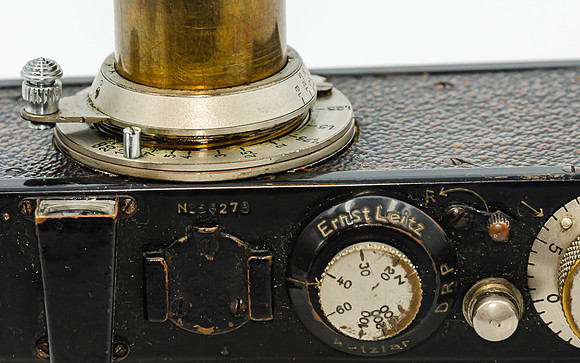
Leica Camera No. 56278 (1930): History, Construction & Significance
Leica serial number 56278 falls squarely within the 1930 production run of the Leica I (Model A)—the camera that defined the 35 mm format and set the template for all modern compact cameras. This places your camera in one of the most historically important production batches in photographic history.
🏭 1. What Leica No. 56278 Actually Is
✔ Model Identification
According to Leica’s official serial‑number ranges, serial numbers 34818–60000 were Leica I cameras produced in 1930.
Your serial number 56278 sits well inside this block.
✔ Camera Type
• Leica I (Model A)
• Fixed, collapsible 50 mm f/3.5 Elmar lens (non‑interchangeable)
• Black enamel finish with nickel fittings
• Cloth focal‑plane shutter (1/20–1/500 s + Z)
This is the “classic” Leica that made 35 mm photography viable.
🔧 2. How It Was Made (Wetzlar, Germany)
Hand‑built precision engineering
• Manufactured by Ernst Leitz GmbH in Wetzlar.
• Assembly was largely hand‑fitted, with shutters individually calibrated.
• Lenses were ground and polished in‑house, then matched to the body.
• The collapsible Elmar lens was inspired by the Zeiss Tessar but optimized by Max Berek for 35 mm film.
Materials & Construction
• Brass body with black enamel paint.
• Nickel‑plated controls (chrome came later).
• Cloth shutter curtains with roller‑spring tensioning.
• Reverse‑Galilean viewfinder—simple but bright.
This combination made the Leica I extremely compact compared to plate cameras of the era.
🌍 3. Historical Significance
⭐ 1. The camera that standardized 35 mm photography
The Leica I (Model A) established 24×36 mm as the global standard for 35 mm still photography—still the basis of today’s “full‑frame” digital sensors.
⭐ 2. A turning point in photographic culture
Before the Leica, photography was dominated by bulky plate cameras.
The Leica I enabled:
• candid street photography
• travel photography
• photojournalism
• spontaneous, handheld shooting
It directly influenced photographers like Henri Cartier‑Bresson, who later adopted Leica rangefinders.
⭐ 3. A milestone in industrial design
The Leica I introduced:
• compactness
• precision engineering
• ergonomic control layout
• collapsible lens design
These principles shaped camera design for the next 70+ years.
⭐ 4. A highly collectible early Leica
Cameras from the 1930 production block are prized because:
• They represent the mature, perfected version of the Model A.
• They are early enough to be historically important but late enough to be mechanically refined.
• Many were heavily used, so well‑preserved examples are rare.
🧭 4. Why Leica No. 56278 Matters Today
It is part of the foundational generation of Leica cameras
Your serial number places it in the era when Leica was transforming photography worldwide.
It is a direct ancestor of every modern 35 mm and full‑frame digital camera
The design philosophy of the Leica I still echoes in today’s cameras.
It is a historically significant collectible
Collectors value:
• originality (lens, shutter, finish)
• condition
• matching serial‑number lens
• completeness (case, accessories)
A 1930 Leica I in excellent condition is considered museum‑worthy.