Origins and Manufacturing Context
Kodak’s digital leadership in the early 1990s
By 1992, Kodak had already produced:
• the first commercial DSLR (DCS 100, 1991),
• the first 1.3–1.5 MP CCDs suitable for professional imaging,
• early RAW formats and digital workflow tools.
But the DCS 100 required a shoulder‑mounted storage unit connected by a thick cable.
The DCS 200 was designed to solve this problem.
Design Goal
Create a portable, integrated digital SLR that:
• professionals could carry like a normal camera,
• stored images internally,
• used a proven 35 mm SLR body for reliability and lens compatibility.
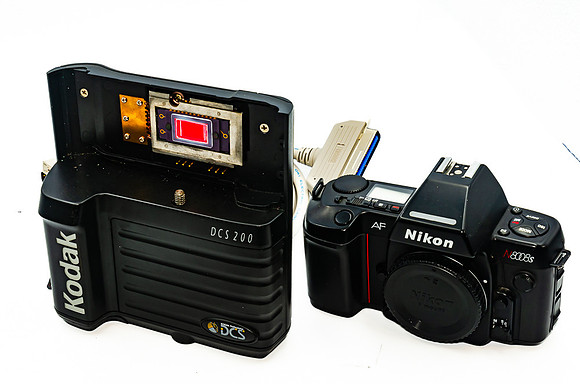
Kodak chose the Nikon N8008s because it had a removable back and robust autofocus system.
🔧 2. Technical Design and Construction
Digital Back
• Sensor: 1.5 MP CCD (1524×1012)
• Sensor size: ~14×9.3 mm (≈2.5× crop factor)
• Storage: built‑in 80 MB hard drive (up to 50 images depending on model)
• Interface: DB‑25 SCSI port for external drives
• Power: separate AA batteries for the Nikon body and the Kodak back
This integration was a major leap forward compared to the DCS 100’s external storage pack.
Camera Body
• Based on Nikon N8008s (F801)
• Full Nikon F‑mount compatibility
• Autofocus and exposure system identical to the film camera
Variants
Kodak released several versions:
• DCS 200c – color
• DCS 200ci – color + internal hard drive
• DCS 200m – monochrome
• DCS 200mi – monochrome + internal hard drive
• DCS 200ir – infrared
These options made the DCS 200 attractive to scientific, forensic, and military users.
🌍 3. Significance in Photographic History
A. The first practical DSLR
The DCS 200 was the first DSLR that:
• stored images internally,
• could be carried and used like a normal SLR,
• required no external processing unit.
This made it the first DSLR suitable for field use.
B. A milestone in digital workflow
The built‑in hard drive and SCSI interface represented early attempts at:
• portable digital storage,
• computer connectivity,
• rapid image transmission.
The U.S. Navy famously used the DCS 200 for fast battlefield image transmission via satellite and radio links.
C. A bridge between film and digital
The DCS 200 preserved:
• Nikon’s optical system,
• Nikon’s ergonomics,
• Nikon’s autofocus,
while adding Kodak’s digital imaging technology.
This hybrid approach defined early DSLRs for more than a decade.
D. A commercial and technological stepping stone
The DCS 200 paved the way for:
• the DCS 400 series (1994),
• the 6 MP DCS 460,
• the Canon‑based Kodak DCS models,
• and eventually the integrated DSLRs of the late 1990s.
It is a foundational camera in the evolution of digital photography.
🎞️ 4. Collectability and Legacy
Why collectors value the DCS 200:
• Second DSLR ever sold commercially
• First self‑contained DSLR
• Rare and historically important
• Early 1990s digital engineering milestone
• Multiple specialized variants (IR, monochrome)
Challenges today
• Hard drives often fail
• Battery systems are awkward
• SCSI connectivity is obsolete
• CCD sensors may degrade
But as a historical artifact, the DCS 200 is unmatched.
🧭 5. Why this camera matters in your collecting framework
Given your interest in engineering transitions, early digital imaging, and historically significant cameras, the DCS 200 is a perfect fit because it represents:
• the moment digital photography became portable,
• a hybrid of Nikon’s film heritage and Kodak’s digital innovation,
• a Cold War–era tool used by military and scientific teams,
• a rare and influential milestone in the digital revolution.
It’s one of the cameras that truly changed the trajectory of photography.