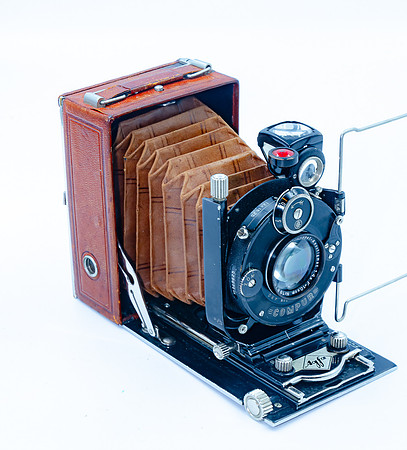
Agfa Isolar Luxus (c.1928): History, Making & Significance
The Agfa Isolar Luxus is one of the most elegant German plate cameras of the late 1920s—essentially a luxury-finished evolution of the Rietzschel Condor Luxus, produced just after Agfa absorbed Rietzschel into the IG Farben conglomerate. Its brown‑leather “Luxus” finish, high‑grade Compur shutter, and Solinear/Doppel‑Anastigmat lenses made it a prestige camera for serious amateurs during a period of rapid industrial consolidation in the German photographic industry.
🏭 1. Origins & Manufacturing Context
Agfa’s acquisition of Rietzschel (1925–1926)
• Agfa purchased the Rietzschel camera works from Bayer during the IG Farben reorganisation.
• Many early Agfa plate cameras—including the Isolar and Isolar Luxus—were direct continuations of Rietzschel designs.
• The Isolar Luxus specifically descends from the Rietzschel Condor Luxus, retaining its double‑extension folding bed and premium finish.
Production period
• Produced from about 1926 into the early 1930s, with the Luxus variants appearing from 1927 onward.
• The 1928 date aligns with the early phase of Agfa’s own branding replacing Rietzschel engravings.
🔧 2. Technical Construction & Features
Formats
• Available in 9×12 cm and 6.5×9 cm plate formats.
• The 9×12 cm version is the most documented Luxus variant.
Lens options
Typical lenses included:
• Agfa Doppel‑Anastigmat 13.5 cm f/4.5 (early units)
• Solinear 13.5 cm f/4.5 (Agfa’s rebranding of the Rietzschel Doppel‑Anastigmat)
Shutters
• Early models: Dial‑set Compur
• Post‑1931: Rim‑set Compur
Camera body & mechanics
• Double‑extension bellows for close‑focus capability.
• Ground‑glass focusing at full aperture.
• Scale focusing for quick operation.
• Two viewfinders on some variants (notably the 408 S).
• Movements: modest vertical and horizontal shifts on certain models.
Luxus finish
• Distinctive brown leather body and bellows, differentiating it from the standard black Isolar.
• Same mechanical specifications as the non‑Luxus models—luxury was aesthetic, not functional.
🌍 3. Historical Significance
1. A symbol of Agfa’s transition from chemistry to camera manufacturing
Agfa was originally a chemical and photographic materials company. After acquiring Rietzschel, it began producing cameras under its own name.
The Isolar series represents Agfa’s first mature generation of in‑house cameras, bridging Rietzschel craftsmanship with Agfa branding.
2. A premium camera for the serious amateur
• Sold at a higher price than Agfa’s mass‑market models (e.g., the Billy).
• Targeted at enthusiasts who wanted plate‑camera precision without the bulk of studio equipment.
• The Luxus finish positioned it as a status object—aesthetic refinement for a growing middle‑class photographic culture.
3. A snapshot of German industrial consolidation
• The Isolar Luxus embodies the IG Farben era, when Agfa, Bayer, and others were reorganised into a massive chemical and photographic conglomerate.
• Early Isolars often show mixed branding (Rietzschel lenses, Agfa shutters), illustrating the transitional manufacturing environment.
4. A collectible today
Collectors value the Isolar Luxus for:
• Its brown leather finish (rarer than the standard black).
• Its role in Agfa’s early camera history.
• Its high‑quality Compur shutter and Solinear lens.
🧭 4. Why the 1928 Isolar Luxus Matters
It represents:
• The fusion of Rietzschel engineering with Agfa’s emerging camera identity.
• A luxury‑market strategy during a period when most companies were racing toward cheaper roll‑film cameras.
• A technical high point for Agfa’s plate‑camera craftsmanship before the company shifted focus to roll‑film and later 35 mm cameras.
In short:
The Agfa Isolar Luxus is a refined, transitional, and historically pivotal camera, capturing the moment Agfa transformed from a chemical giant into a full‑fledged camera manufacturer.