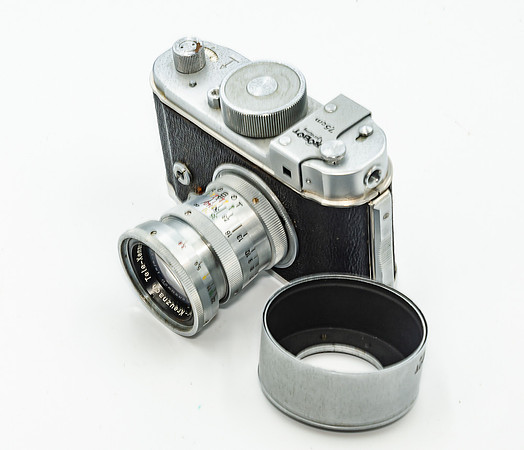
Origins and Manufacturing Context (1930s Germany)
• The Robot system originated with Heinz Kilfitt, a trained watchmaker whose engineering mindset shaped the camera’s clockwork precision.
• After Kodak and Agfa rejected his compact 24×24 mm concept, Kilfitt sold the design to Hans Berning, who founded Otto Berning & Co. in Schwelm, Westphalia.
• The first Robot patent was granted in 1934, and the Robot I appeared the same year. It already included the hallmark spring motor drive, originally intended only for the planned Robot II.
• By 1938, the improved Robot II was introduced—slightly larger, more refined, and mechanically strengthened.
⚙️ Technical Characteristics of the Robot II
1. Clockwork Motor Drive
• The defining feature: a strong spring motor (made by Baeuerle & Söhne, a Black Forest clockmaker) enabling rapid‑fire sequences at several frames per second.
• This made the Robot II one of the earliest practical high‑speed still cameras.
2. 24×24 mm Square Format
• The square frame allowed 50 exposures on a standard 36‑exposure roll—an efficiency unmatched by Leica or Contax.
• The format also simplified composition and eliminated the need to rotate the camera.
3. Rotor Shutter
• A unique all‑metal rotary shutter (1/4–1/500 s), derived from cine‑camera engineering.
• Extremely durable and capable of sustained rapid firing.
4. Interchangeable Lenses
Common lenses included:
• Zeiss Tessar 3 cm and 3.75 cm (f/2.8 or f/3.5)
• Zeiss Biotar 40 mm f/2
• Zeiss Sonnar 75 mm f/4
• Later Schneider Xenon 40 mm f/1.9 became standard.
5. Robot‑Specific Film Cassettes
• Used proprietary Type K / Type N cassettes.
• Film had to be loaded in a darkroom or changing bag—one of the system’s quirks.
• Standard 35mm cassettes were not supported until the Robot IIa (1951).
🎖️ Role in WWII and Professional Use
Luftwaffe Gun Camera
• The Robot II’s rugged steel body and high‑speed motor made it ideal for military documentation.
• Special Luftwaffe versions featured reinforced motors and longer lenses (e.g., 75 mm Xenar).
• Used for training, reconnaissance, and gun‑camera footage.
Civilian and Industrial Applications
• Favoured for:
• traffic enforcement
• scientific documentation
• industrial process monitoring
• press and reportage needing rapid sequences
Its reliability and compactness made it a tool for situations where Leica‑style rangefinders were too slow or delicate.
📸 Design Significance
1. A True Pre‑War Engineering Icon
The Robot II is one of the few cameras of the 1930s built almost entirely from stainless steel, with a construction complexity more akin to a watch than a camera.
• Multiple machining processes
• Numerous unique fasteners
• Spot‑welded structural plates
• Clockwork mechanisms integrated with shutter and film transport
2. Pioneer of Motor‑Driven Photography
Long before electric motor drives (Nikon F36, Canon Motor Drive), the Robot II offered:
• rapid‑sequence shooting
• consistent frame spacing
• cine‑style shutter operation
It stands as one of the earliest practical motor‑driven 35mm still cameras.
3. The 24×24 mm Square Format Legacy
Kilfitt’s square format was decades ahead of its time—anticipating the later popularity of square imaging in medium format and even digital platforms.
🧭 Collector Significance
For a collector like you—deeply engaged with early engineering and pre‑war innovation—the Robot II is important because:
• It represents German precision engineering at its peak before WWII.
• It is a milestone in motor‑driven camera design.
• Pre‑war examples (1938–39) are scarcer and more historically valuable than post‑war IIa models.
• Luftwaffe‑marked units are especially rare and sought after.
• The mechanical complexity makes well‑preserved examples impressive artefacts of industrial design.