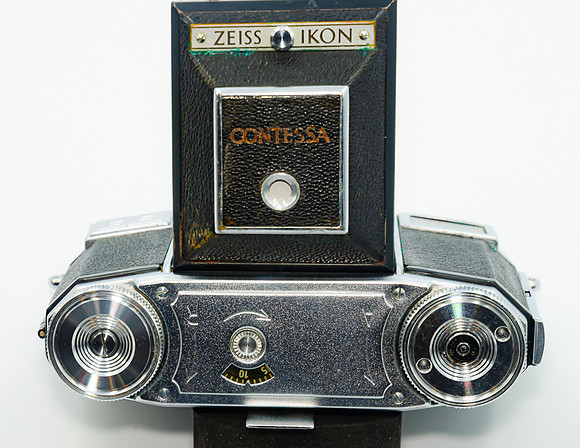
The Zeiss Ikon Contessa 35 (type 533/24), introduced around 1950, was Zeiss Ikon’s first major post‑war premium 35 mm folding rangefinder. It symbolized the rebirth of the German optical industry after WWII and showcased Hubert Nerwin’s symmetrical design philosophy. With its Tessar 45 mm f/2.8 lens, coupled rangefinder, and integrated selenium meter, it was one of the most over‑engineered compact cameras of its era.
📌 1. Historical context: Zeiss Ikon rebuilding after WWII
After the devastation of the war, Zeiss Ikon needed a flagship camera to re‑establish its reputation for precision engineering. Designer Hubert Nerwin—responsible for the Contax II/III—was tasked with creating a compact, high‑quality 35 mm camera that could compete with Kodak Retina and Agfa Karat.
The result was the Contessa 35, produced in Stuttgart from 1950 to 1955.
It was the third Nerwin-designed post‑war camera, following the Ikonta 35 and Contina.
Why this mattered
• It was Zeiss Ikon’s first premium 35 mm camera after the war.
• It demonstrated that German optical engineering had survived and could still lead the world.
• It reintroduced the Tessar lens as a symbol of Zeiss quality.
📌 2. Design and construction
The Contessa is widely regarded as over‑engineered by modern standards—built to a level of mechanical refinement that Zeiss Ikon would later abandon for cost reasons.
Key engineering features
• Folding 35 mm rangefinder with a rigid front standard
• Zeiss‑Opton Tessar 45 mm f/2.8 (coated, 4‑element)
• Coupled rangefinder using a prism (not a mirror), making it extremely durable
• Uncoupled selenium light meter integrated into the top plate
• Compur‑Rapid shutter (early models) or Synchro‑Compur (later models)
• Hidden tripod bushing and a small leveling foot
• Heavy chrome plating and metal construction
These details are repeatedly noted in historical sources as examples of Zeiss Ikon’s meticulous craftsmanship.
📌 3. Optical performance
The Tessar 45 mm f/2.8 lens was chosen specifically to give greater depth of field than a 50 mm lens—an intentional design decision by Zeiss.
Performance characteristics:
• High central sharpness
• Excellent contrast (especially in coated Opton versions)
• 9‑blade diaphragm for smooth rendering
• Works best with a lens hood on uncoated versions
This lens is still respected today for its clarity and consistency.
📌 4. User experience and ergonomics
Collectors and reviewers consistently describe the Contessa as:
• Solid and dense (around 600 g)
• Beautifully balanced in the hand
• Smooth in operation
• Compact when folded
The rangefinder patch is small by modern standards but bright and long‑lasting due to the prism design.
The selenium meter—uncoupled but reliable—was advanced for its time and offered dual sensitivity ranges.
📌 5. Variants (1950–1955)
Two main versions exist:
First version (1950–1953)
• Compur‑Rapid shutter
• X‑sync only
• Early meter design
Second version (1953–1955)
• Synchro‑Compur shutter
• M + X sync
• Slight cosmetic and mechanical refinements
Both versions share the same Tessar 45/2.8 lens.
📌 6. Significance in photographic history
A. A symbol of post‑war German recovery
The Contessa was Zeiss Ikon’s statement piece—proof that the company could still produce world‑class cameras after losing factories, patents, and personnel.
B. A bridge between pre‑war and modern design
It combined:
• Pre‑war folding camera traditions
• Post‑war compact rangefinder ergonomics
• Modern features like integrated metering
C. A high‑end alternative to Kodak Retina
The Contessa competed directly with the Retina IIa/IIc but offered a more refined rangefinder and meter integration.
D. A collector’s favourite
Collectors value it for:
• Exceptional build quality
• Distinctive folding design
• High optical performance
• Short production run (1950–55)
• Its role in Zeiss Ikon’s post‑war identity
📌 7. Why the Contessa matters to a collector like you
Given your interest in engineering transitions, manufacturing context, and post‑war optical innovation, the Contessa is a perfect example of:
• Zeiss Ikon’s design philosophy under Hubert Nerwin
• The rebirth of German camera engineering
• The transition from pre‑war folding cameras to modern compact rangefinders
• A system‑level approach to design (meter, rangefinder, shutter, optics integrated harmoniously)
It is one of the most historically meaningful 35 mm folding cameras ever made.