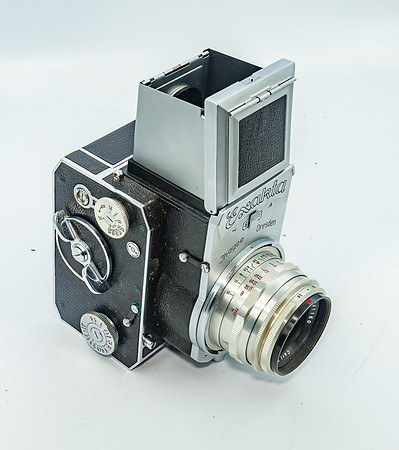
Historical Context (Post‑war Dresden, 1948–1952)
Ihagee’s situation after WWII
• Dresden was devastated by bombing in 1945.
• Ihagee’s founder, Johan Steenbergen, fled to the West.
• The factory was taken over by the Soviet‑controlled GDR.
• Production restarted slowly, using surviving machinery and staff.
The company needed a new flagship to re‑establish itself internationally.
The 35mm Exakta was already world‑famous, so Ihagee attempted something bold:
a medium‑format SLR using the same design philosophy.
Development timeline
• 1948–1950: prototypes of a 6×6 SLR tested
• 1951: small‑scale pre‑production
• 1952: limited production of the Exakta 6×6
• 1953: project abandoned due to mechanical complexity and political pressure to consolidate camera production in the GDR
Total production is estimated at < 10,000 units, possibly as low as 3,000–5,000.
2. Design and Technical Characteristics
A true medium‑format SLR
The Exakta 6×6 was one of the earliest attempts to build:
• a reflex camera,
• with interchangeable lenses,
• for 6×6 cm roll film,
• in a compact, hand‑held form.
This was years before the Pentacon Six (1956) and contemporaneous with early Hasselblad models.
Key features
• Film: 120 roll film, 6×6 cm negatives
• Shutter: focal‑plane cloth shutter, 1/25–1/1000 + B
• Viewfinder: waist‑level finder with magnifier
• Lens mount: proprietary Exakta 6×6 bayonet
• Standard lens: Tessar 80mm f/2.8 (Carl Zeiss Jena)
• Body: die‑cast alloy, leatherette covering
• Advance: knob wind
• Mirror: non‑returning (image blacks out until shutter recocked)
Design philosophy
The camera was essentially a scaled‑up Exakta Varex, retaining:
• left‑hand shutter release,
• front shutter speed dial,
• angular body shape,
• modular viewfinder system.
But the larger format pushed the mechanical limits of the design.
3. Why the Exakta 6×6 Was Important
1. One of the earliest 6×6 SLRs
At the time, medium‑format photography was dominated by:
• TLRs (Rolleiflex, Rolleicord),
• folding cameras,
• box cameras.
A 6×6 SLR was a radical idea.
Only Hasselblad (1948) was ahead — and even Hasselblad was still refining its concept.
2. A bold engineering experiment
Ihagee attempted to:
• scale up a 35mm SLR mechanism,
• maintain high shutter speeds,
• keep the camera portable.
This was extremely difficult with 6×6 film and a large mirror.
3. A symbol of post‑war East German innovation
Despite political and economic chaos, Dresden engineers produced:
• a sophisticated shutter,
• a modular viewing system,
• Zeiss Jena optics.
The Exakta 6×6 shows the technical ambition of early GDR camera production before centralization under VEB Pentacon.
4. A commercial failure that shaped future designs
The camera suffered from:
• shutter reliability issues,
• mirror vibration,
• mechanical fragility,
• high production costs.
Its failure directly influenced:
• the design of the Pentacon Six,
• the abandonment of medium‑format SLRs by Ihagee,
• the consolidation of Dresden camera factories.
4. Collector Significance
Why collectors value it
• Very low production numbers
• Unique place in SLR history
• Zeiss Jena optics
• Distinctive Exakta styling
• Represents a “lost branch” of SLR evolution
Rarity
The Exakta 6×6 is significantly rarer than:
• Exakta Varex models,
• Pentacon Six,
• Praktisix,
• Hasselblad 1000F.
Surviving examples often have shutter or mirror issues, making working specimens even more desirable.
Design appeal
Its angular, almost Art‑Deco industrial form makes it visually striking — a favourite among collectors of early SLRs.
5. Summary
The Exakta 6×6 (c.1952) is a historically significant but commercially unsuccessful attempt to create a medium‑format SLR in the early post‑war years. It represents:
• early GDR engineering ambition,
• a rare experiment in scaling up the Exakta concept,
• one of the first 6×6 SLRs ever made,
• a transitional step toward later East German medium‑format systems.
Today it stands as a rare, fascinating, and highly collectible artifact of photographic history.